Facebook
 Google
 GitHub
 Linkedin
Leuze’s Latest Inductive Sensors Feature Contactless Detection at Longer Ranges
The newest sensor series from Leuze provides users with the low-cost and compact design of inductive sensors while featuring up to a 40 mm switching distance for larger-range applications.
One drawback of inductive sensors has been their short sensing distance capabilities. In response, Leuze has created a new inductive sensor capable of sensing metallic objects at a longer distance. The benefits of inductive sensing, like low cost and simplicity, are finally available for applications that require more distance.

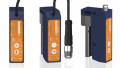
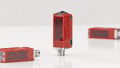
Leuze’s new IS 200 series sensors are inductive sensors capable of detection distances up to 40 mm. Image used courtesy of Leuze
Inductive Sensors in Industrial Automation
Inductive sensors are used to detect the presence, absence, or position of metal objects without direct contact. They are commonly used in industrial automation to monitor machinery, conveyor belts, and robots. These sensors are crucial for speed monitoring, object counting, and upholding safety by detecting potential hazards. Inductive sensors play a role in manufacturing processes, packaging, and automotive systems, offering reliable performance in harsh environments and improving overall operational efficiency for some tasks.
These sensors operate by generating an electromagnetic field in front of themselves. When a metal object enters this field, the object changes the inductance of the sensor's coil. This change is detected by the sensor, which then converts it into a signal indicating the presence or position of the metal object. Inductive sensors typically consist of an oscillating circuit and a detection mechanism that interprets variations in the electromagnetic field caused by metal interference, enabling non-contact detection and measurement.
Leuze IS 200 Series Sensors
Leuze’s new IS 200 series inductive sensors provide switching distances of up to 40 millimeters within compact, cylindrical housings. The sensor’s design makes them ideal for applications with limited installation space, larger distances, or machines with wider tolerances. Additionally, these sensors can detect metal objects that are not perfectly positioned, helping to reduce collision risks during operation.

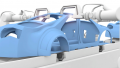
Leuze’s IS 200 series sensor depicted helping to position an industrial crane system. Image used courtesy of Leuze
Leuze has worked to ensure that its IS 200 series sensors feature a high degree of flexible implementation. The IS 200 series sensors are offered in cylindrical M12, M18, and M30 housings made from nickel-plated brass. Two mounting options are available to suit individual customer needs: quasi-embedded and non-embedded. The sensors are designed for reliable detection, meaning they can monitor moving machine components, tools, input materials, and end products made from steel, aluminum, copper alloys, or stainless steel.
Cost-Effective and Robust Detection
The extended switching distance the new compact sensors provide ensures they cover multiple operating ranges, which supports a more cost-effective system design. A robust design can help provide a long lifespan for the sensors, even in a difficult industrial environment. With a more detailed look, users can see that the IS 200 series devices meet the IP67 protection class standards for durability and resilience in challenging environments with dirt and vibration. Lastly, a robust design allows them to function reliably within a broad temperature range of -25 to 70 °C, meaning sensor implementation is possible in harsh industrial environments.
Related Content