Facebook
 Google
 GitHub
 Linkedin
A Small Sensor With Big Reach: A Look at Baumer’s Latest Ultrasonic Sensor
Baumer’s new UF300 ultrasonic sensor combines a 3 m sensing range and 50 mm blind range with a slim 18 mm depth, offering compact detection in intralogistics and manufacturing applications.
Ultrasonic sensors do a lot of heavy lifting in intralogistics, but they’re not always easy to place. Long ranges usually come in housings that are too deep, and the speed drops off when surfaces don’t reflect sound cleanly. Add in the tight spaces around conveyors and pallet guides, and it becomes obvious why sensor selection is often the bottleneck in the design.
To tackle these challenges, Baumer has designed its new UF300 compact ultrasonic sensor with a full 3 m sensing range, a 50 mm blind zone, and an 18 mm installation depth. Built around the company’s NexSonic technology, Baumer intends the UF300 to be used in systems that need long reach but cannot spare the footprint of traditional ultrasonic hardware.
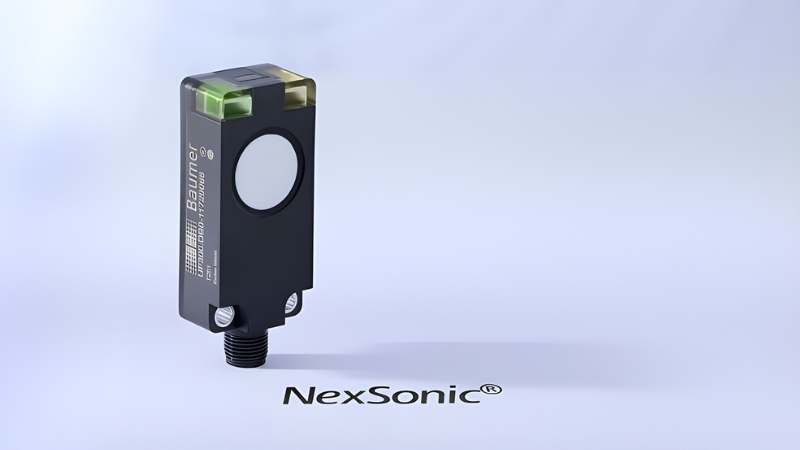
Baumer has expanded its ultrasonic sensor line with the UF300 sensor, which features a 3 m sensing range in a slim build. Image used courtesy of Baumer
NexSonic UF300 Ultrasonic Sensor
Baumer has designed its NexSonic UF300 ultrasonic sensor with a long reach and a very small footprint. Fitting a 3 m ultrasonic range into an 18 mm-deep housing means the sensor can slide into places where a typical unit would collide with brackets or stored product. The short blind zone of only 50 mm also helps when objects sit right up against the sensing face. Instead of waiting for clearance, the UF300 can start measuring almost immediately.
The sensor’s reaction time keeps pace as well. With measurements available in roughly 56 ms, the sensor stays useful on fast conveyor lines and sorting points where delays quickly propagate into the rest of the control sequence.
The UF300 joins Baumer’s existing lineup, which spans six ultrasonic sensor families. The UF300 is available in switching and measuring variants and is designed to reduce the number of models engineers must keep on hand by extending range without increasing bulk.
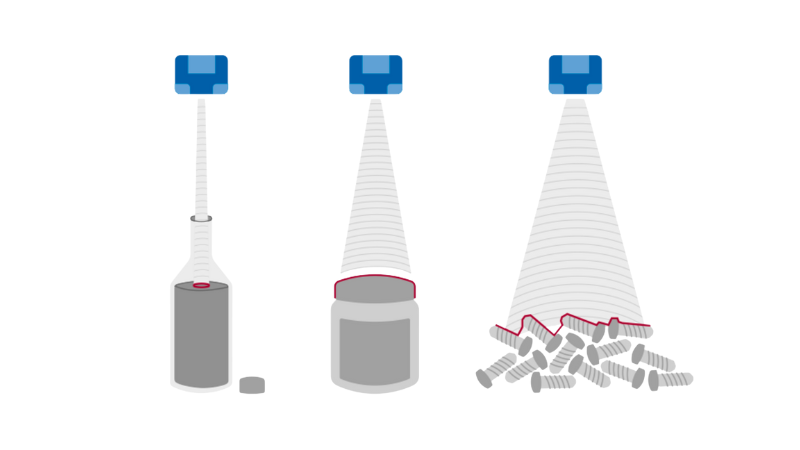
With Baumer’s NexSonic technology, the UF300 features an adaptive sonic cone to help avoid false triggers. Image used courtesy of Baumer
Inside Baumer’s NexSonic Technology
The UF300’s performance comes from Baumer’s NexSonic ultrasonic technology, which combines Baumer’s custom ultrasonic ASIC and a patented sensor element. In this design, the piezo element is directly connected to the membrane, eliminating some of the intermediate structures found in conventional designs. Less distance for the signal to travel means faster processing, improved EMC behavior, and lower susceptibility to electrical noise.
The evaluation electronics are compact as well, enabling tight timing control and stable measurement even when background reflections or irregular target shapes complicate the environment.
The UF300 will also come with features such as an adaptive sonic cone and configurable filter functions that help avoid false triggers when objects pass through narrow guides or when nearby structures can confuse a typical ultrasonic beam.
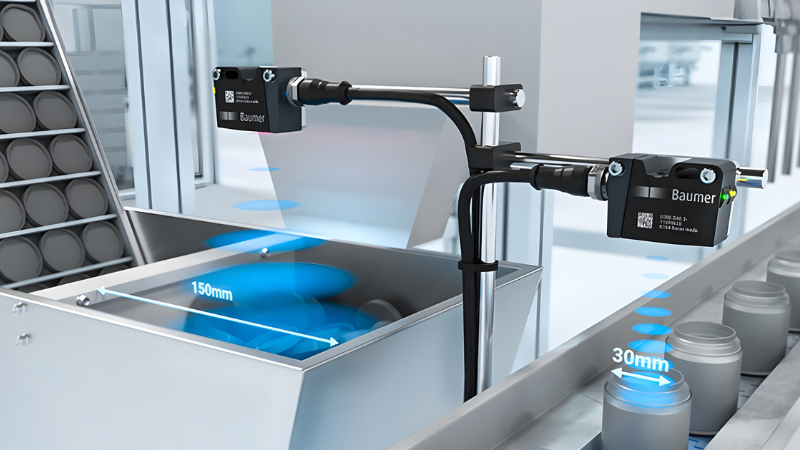
Engineers can deploy the UF300 in a variety of applications, from fill level monitoring to pallet detection in forklift applications. Image used courtesy of Baumer
Compact Ultrasonic Sensing
By delivering a 3 m sensing range in a slim 18 mm form factor, the UF300 gives equipment designers more freedom to place ultrasonic detection where space and reliability are equally tight. The sensor’s NexSonic processing and fast response times aim to help the sensor track difficult targets without demanding a larger housing.
The UF300 is especially suitable for applications with long mechanical spans or challenging atmospheres. Extended fork-arm pallet detection and vertical stack monitoring require both reach and a shallow form factor, and gate systems in chilled or frozen environments often need an alternative to optics.
Baumer predicts the UF300’s signal handling will also help maintain reliability in automated packaging lines and electronics production present detection with surfaces that may absorb or scatter acoustic energy.
Related Content