Facebook
 Google
 GitHub
 Linkedin
MiR Releases the MC600 Mobile Cobot for High-Payload Tasks
Mobile Industrial Robots (MiR) has launched a new mobile collaborative robot, the MC600, bringing mobility to heavy-payload tasks in applications such as palletizing and machine tending.
Mobile Industrial Robots (MiR) has released its latest heavy-lifting, MiR Go-approved mobile collaborative robot, the MiR MC600. The newest robot from both Teradyne Robotics companies, MiR and Universal Robots, is part of the duo's ongoing efforts to evolve robotic automation to meet the needs of industrial customers worldwide.
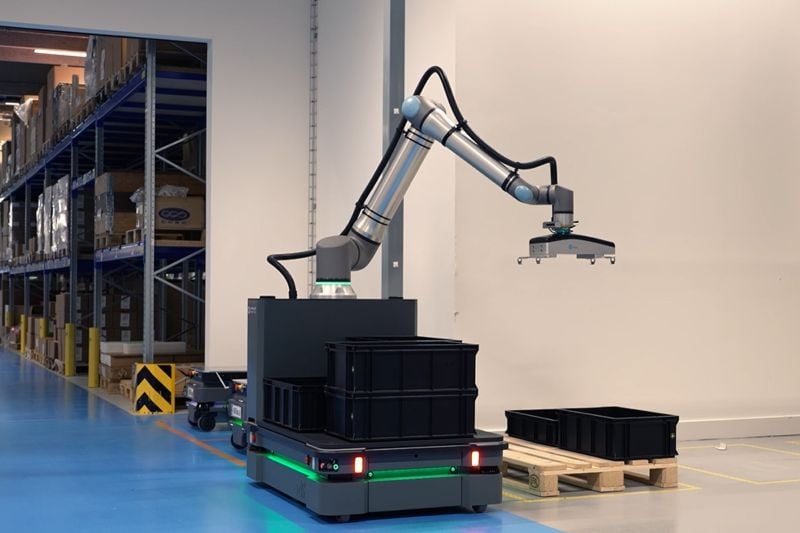
The MC600 combines a mobile MiR600 base with a heavy-load-bearing UR20/UR30 cobot arm. Image used courtesy of Mobile Industrial Robots
MC600 Mobile Cobot
Mobile cobots are adaptable and can navigate their environment, providing manual handling capabilities that augment human work. Mobile cobots can transport heavy loads across warehouse shop floors, saving energy expenditure and potential injury to human workers. Employing mobile cobots also allows operations to run well beyond the hours capable of human workers. Errors in workflows are also less likely, which equates to greater accuracy and efficiency across facility operations.
MiR’s MC600 mobile collaborative robot, designed for heavy payloads, is the newest addition to MiR’s mobile cobot lineup. MC600 employs a Universal Robots’ cobot (UR20 or UR30) and the MiR600 mobile robot base that can handle heavy loads weighing up to 600 kg.
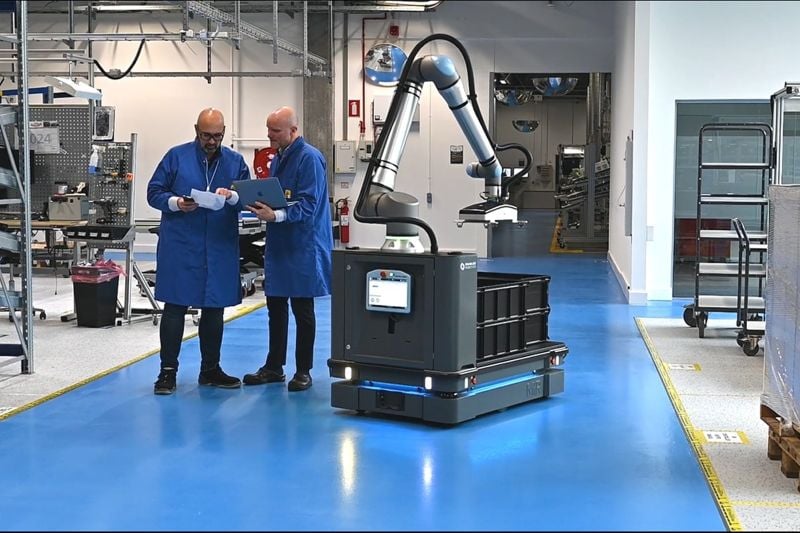
The MC600 is designed to work alongside human workers, using sensor technology to navigate its surroundings and avoid obstacles. Image used courtesy of Mobile Industrial Robots
Enabled Robotics Software
The MC600’s robotic arms and mobile base are coordinated through MiR Go partner Enabled Robotics’ ER-ABILITY software. MC600 operators can access the ER-ABILITY software through a web-based interface via tablet, computer, or smartphone. The software features block-based drag-and-drop programming, customizable and pre-programmed blocks, and a standard user interface for scheduling. MC600 operators also have access to Enabled Robotics’ ER-VISION for fixed marker calibration (to 1 mm) and 2D and 3D object detection.
Palletizing and Machine Tending
In addition to the new MC600, MiR offers a smaller mobile cobot, the MC250. Because it is smaller, the MC250 is perfect for lighter jobs including sorting small objects, light pick-and-place work, and precision assembly. It works well with lightweight production processes that require swiftness and agility.
The new, larger MC600 is offered as a kind of two-for-one system with the ability to tackle both machine-tending and palletizing applications because of the integration of adaptable mobile robot components and cobot arms from Universal Robots. The MC600 is designed to help increase production line efficiency in manufacturing by handling bulky completed goods, automating large part assemblies, and transferring heavy raw materials.
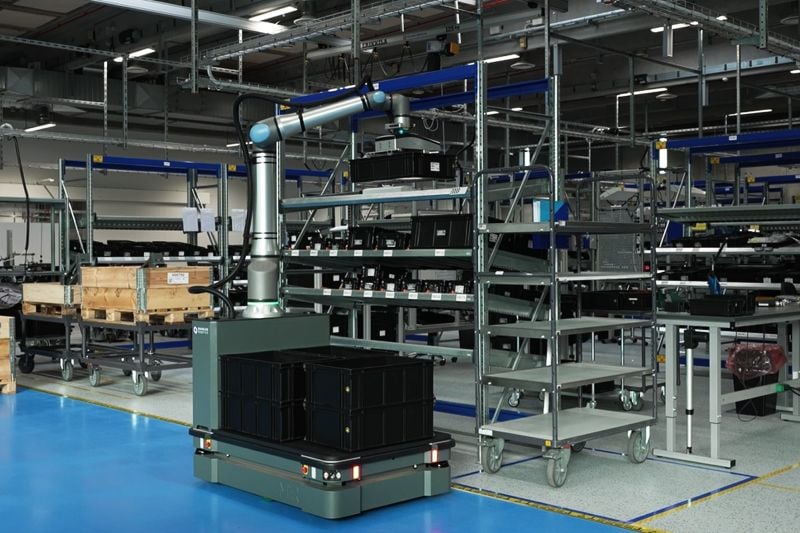
The MiR MC600 is designed for heavy-payload tasks in palletizing and machine tending applications. Image used courtesy of Mobile Industrial Robots
As an example, the MC600 can help regulate the installation and transfer of heavy metal components into CNC machines in an automotive manufacturing facility. Delivering parts to several machining stations, the MiR600 AMR moves around the manufacturing floor on its own. These heavy parts are picked up by the MC600's high-payload UR20/UR30 cobot, which then precisely places them in the processing machine before removing the completed parts and depositing them onto pallets for assembly or transportation.
Global Market for Mobile Cobots
According to Verified Market Research, the mobile cobot market is projected to rise (from 9.12 billion in 2023) at a compound annual growth rate of 26.1%, reaching USD 54.9 Billion by 2031.
Innovations in artificial intelligence, machine learning, sensing technology, edge devices, and wireless communications are key drivers behind mobile cobot technology's expansion. The continued labor shortage (across sectors such as logistics, manufacturing, and healthcare) and the ability to improve worker safety are other key drivers of mobile cobot technology growth.