Facebook
 Google
 GitHub
 Linkedin
Physik Instrumente’s Nanopositioning Stage Delivers Precise 6-Axis Motion
Physik Instrumente has released a positioning system that delivers precise and repeatable nanoscale movements controlled in six axes for applications like metrology, photonics, and micro-assembly.
Physik Instrumente (PI) has developed a new, six-axis stage that can position objects with nanoscale-level precision. The F-690.S1 nanopositioning system provides a means to make quick, yet tightly controlled motions, accurately positioning optical equipment, semiconductor wafers, probes, and other such hardware for testing and manufacturing purposes.
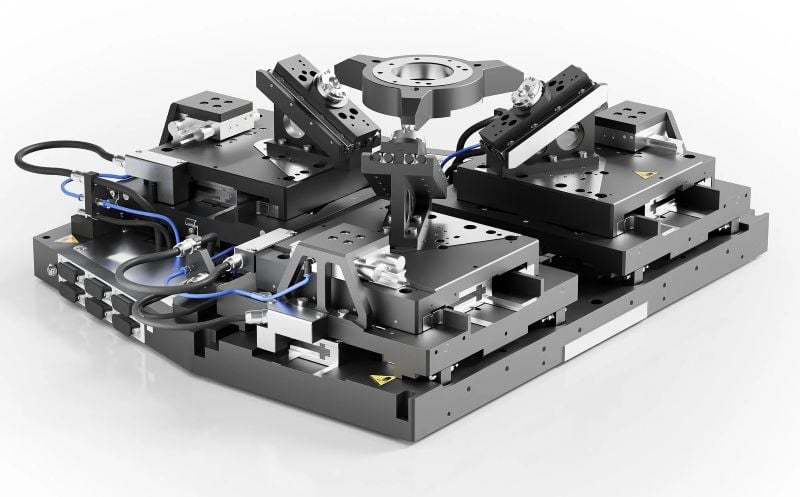
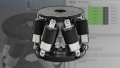
The F-690.S1 nanopositioning stage brings precise, six-axis motion to industrial and research applications. Image used courtesy of Physik Instrumente
Six-Axis Nanopositioning System
Physik Instrumente’s new F-690.S1 six-axis nanopositioning system is capable of tiny, tightly controlled motions, while still being able to manipulate payloads of up to 2 kg. All motion is performed by electromagnetic motors using a parallel-kinematic architecture, meaning movement is fast and precise. Furthermore, the nanopositioning stage has a slim profile, making it suitable for embedding in instrumentation or test equipment without significantly adding to the bulk of the machine.
Included with the F-690 are Fast Multi-Channel Photonics Alignment (FMPA) algorithms for optimizing optical alignment operations. These algorithms can do fast-scanning and gradient-based searches in three dimensions, both of which help locate the maximum coupling between optically-linked objects. Furthermore, there is an optional PILightning module that determines when light is first detected at the object being aligned. All of this is made possible through the ACS motion controller that comes preconfigured from PI.
The F-690.S1 demonstrating its multi-axis motion capabilities. Video used courtesy of Physik Instrumente USA
Multi-Axis Motion
The F-690 stage can be controlled in six axes: X, Y, Z, roll, pitch, and yaw. While plenty of manipulators can perform six-axis motion, the precision of the F-690 makes it stand apart. For X, Y, and Z positions, one nm resolution is possible using absolute measuring sensors, and it can be moved in 10 nm steps.
The stage is capable of making linear motions at speeds of up to 500 mm/s. In terms of rotation, the stage can step as small as 2 μrad (0.000115॰) and can perform these rotations at 100॰/s through the full range of each axis.
Not only is this stage precise, but it also makes the necessary motions quickly. Positions are repeatable to a high degree of accuracy as well. An incremental motion test revealed that the position can be stepped up 10 nm at a time, and then stepped back down repeatably. This shows that the stage does not suffer from hysteresis errors.
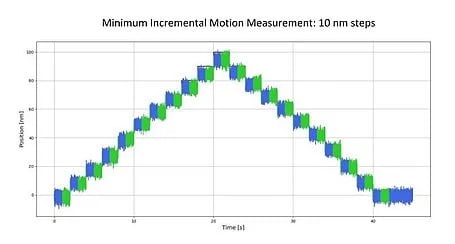
Step test performed by the F-690.S1 showing repeatability in 10 nm minimum incremental motion. Image courtesy of Physik Instrumente
Precision Automation Applications
Nanometer-scale precision motion control may seem like overkill for most automation systems. A robot picking and packing does not need this fine level of control; however, plenty of applications do.
PI envisions these new positioning stages as essential for manipulating lasers, mirrors, lenses, and other optical equipment found in many metrology and characterization tools. The stages will help align fiber optic communications equipment and will likely see service for testing and sorting of semiconductor manufacturing operations, where nanoscale testing is required.
Overall, the number of applications requiring this level of control is expected to grow as the photonics and semiconductor industries continue to shrink the physical size of their products.