Facebook
 Google
 GitHub
 Linkedin
Plugging the Gap: Binder Links Old and New Power Systems
Binder adds redesigned 7/8" splitters, new M12 L-coded splitters, and hybrid adapters, helping engineers manage modern and legacy automation networks.
Factories are getting smaller. Machines that once occupied entire rooms are being redesigned into compact, modular systems. That’s good for efficiency, but it creates a new challenge. How do you deliver the same amount of power when the physical space for connectors continues to shrink? That’s where Binder, a specialist in industrial circular connectors, is steering its portfolio. The company has rolled out new M12 Power components, new 7/8" options, and a line of adapters to connect the two. Together, they’re aimed at engineers who need to keep pace with miniaturization while still maintaining older systems already in the field.
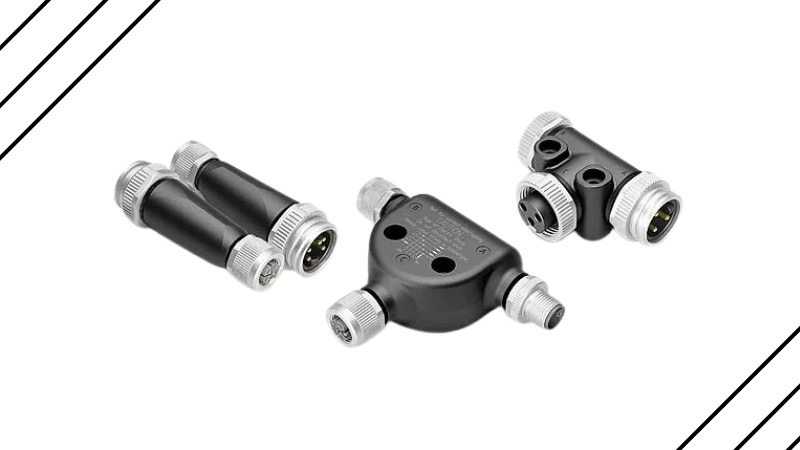
A variety of Binder’s new offerings. Image used courtesy of Binder
The Rise of M12 Power
M12 connectors have become the go-to choice in modern automation. They’re compact but can still deliver voltages up to 630 V, more than enough for drives, lighting, or distributed control systems. Different codings (S, K, L, and T) define whether a connector is set up for AC or DC, giving engineers safe and predictable options in the same familiar form factor.
Their strength is adaptability. You’ll see them in AC motors, frequency converters, LED arrays, or network devices. For anyone building smaller control panels, the M12 is hard to beat because it squeezes real power into tight layouts.
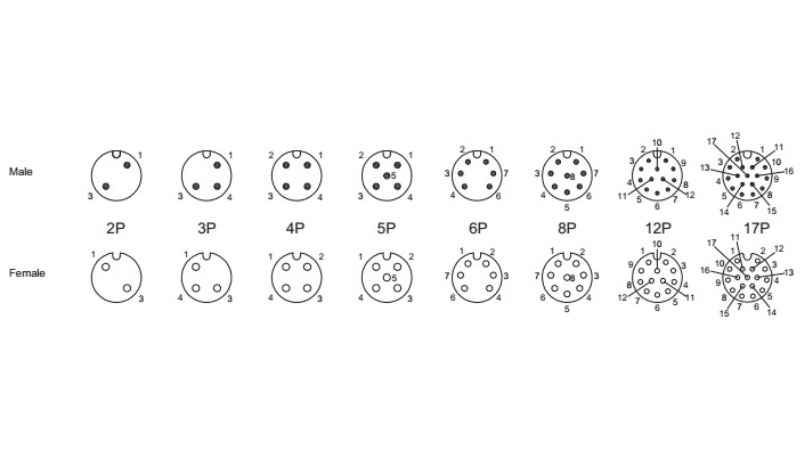
An image to further clarify M12 connectors. Image used courtesy of Ultra Librarian
Why 7/8" Still Matters
The older 7/8" format isn’t going away. In the U.S., where miniaturization trends have been slower, 7/8" connectors remain common in legacy equipment. They’re larger, but they’re also robust and can handle higher loads without issue. For existing plants, replacing every 7/8" connector just isn’t practical. That’s why Binder continues to update the line rather than phase it out. It’s a recognition that many engineers work in hybrid environments where “old” and “new” systems run side by side.
What’s New in the Lineup
Binder’s latest updates include three key additions:
- Redesigned 7/8" T-Splitter: Available in 3-, 4-, and 5-pin versions, this update adds integrated mounting holes for easier installation, replacing the company’s earlier model.
- 5-Pin M12 L-Coded T-Splitter: Built for modern DC power distribution, this splitter provides structured branching in compact spaces. Perfect for decentralized systems where a small footprint matters.
- Hybrid Adapters (7/8" to L-Coded M12): These connectors link old and new setups, letting engineers modernize gradually without tearing out existing wiring.
Each product meets IP67 or IP68 protection, supports over 100 mating cycles, and complies with UL2237 and UL2238 safety standards.
Where Splitters Shine and Where They Don’t
Splitters are all about efficiency. In decentralized systems, they let engineers branch power lines neatly, cutting down on cable runs and simplifying layouts. That’s valuable in factory automation, lighting systems, or distributed motor control. However, they aren’t a silver bullet. In ultra-compact devices, there may not be room for splitters at all, and direct cabling could be the only option. Also, adding more connection points might complicate reliability in harsh vibration or high-shielding environments. The lesson: Use them where they add clarity and structure, and avoid them where simplicity matters most.
Supporting Both Eras of Automation
Binder’s strategy reflects how factories evolve in practice, not by replacing everything at once, but by layering new technologies over existing systems. The updated splitters and adapters give engineers options to do exactly that.
The new M12 L-coded splitter speaks to modern compact machines. The redesigned 7/8" splitter addresses high-power legacy setups. And the hybrid adapters help bridge the two worlds. For engineers, the benefit is flexibility. Instead of forcing a full transition to one connector standard, Binder is providing tools that make modernization gradual, practical, and cost-effective.