Facebook
 Google
 GitHub
 Linkedin
Posital Shrinks Multiturn Magnetic Encoders Down to a 20 mm Diameter
The 20 mm encoders are the latest addition to Posital’s IXARC series rotary encoders. The new encoders offer a compact, near maintenance-free design for use in precision motion control applications.
Posital has expanded its IXARC rotary encoder series with a multiturn magnetic encoder line featuring a 20 mm diameter. The latest encoder is smaller than any other encoder in Posital’s multiturn lineup, with a housing length of only 31 mm, making it suitable for use in tight spaces.
Furthermore, these encoders come with 16-bit resolution and Posital’s Wiegand energy-harvesting system for battery-free operation. The new encoders will be available in limited quantities in Q1 of 2026, with full-scale availability later next year.

Posital’s smallest multiturn encoder features a diameter of just 20 mm. Image used courtesy of Posital
20 mm Multiturn Magnetic Encoders
The newest IXARC multiturn encoder’s compact footprint makes it ideal for machine and robotics designers who want to pack functionality into a small space. It features a connector clip that allows it to be mounted axially or radially, adding flexibility to designs.
Besides the small form factor, Posital has designed its new IXARC encoders to be easily integrated with other hardware. Communication is possible using BiSS C and SSI protocols, both of which are widely used in precision machine control applications. The encoders are available in both hollow shaft and solid shaft models and are encased in a stainless steel housing, making them corrosion resistant. Each encoder is essentially maintenance-free, meaning it can be embedded deep in machine systems.
Posital intends for the encoder’s small size to not limit its capability. The encoder uses a tunnel magnetoresistance (TMR) sensing technique, which gives it a 19-bit single-turn resolution or a 16-bit multiturn resolution.
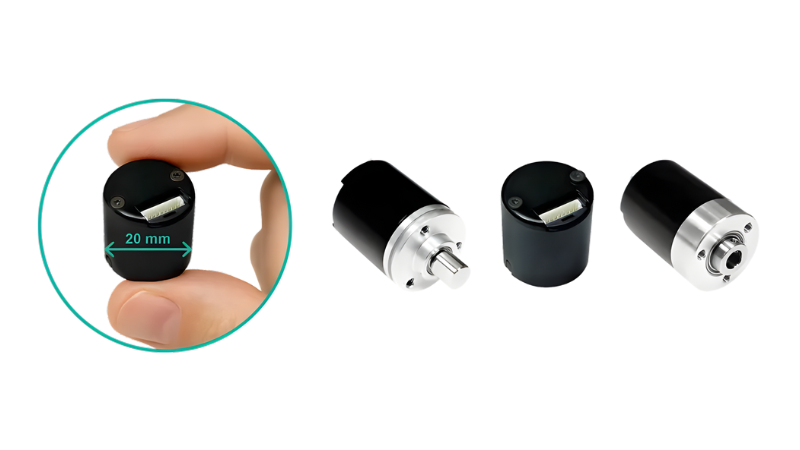
The 20 mm diameter multiturn magnetic encoders feature a near maintenance-free, battery-less design. Image used courtesy of Posital
Battery-Free Multiturn Position Tracking
The new IXARC encoders use an enhanced signal processing routine to minimize power usage while providing excellent signal stability. This is made possible through the use of Posital’s Wiegand energy-harvesting system. In this system, each pulse generates enough electrical energy to power the internal counting electronics. This means the encoder needs no additional battery or external power backup source to operate.
Another advantage of the new IXARC encoders is that accurate counting is possible despite a system shut down thanks to Posital’s energy-harvesting system. This is essential for many precision robotics applications. Consider a powered microscope with a moving stage. Without this feature, a power outage may cause the microscope to lose the position of the stage. When the power returns, it might move the stage into the optics of the microscope. With the encoder’s energy-harvesting system and absolute positioning, this is highly unlikely.
This system also keeps track of position while maintenance is being performed to a machine. Maybe a component needs to be moved slightly to access another piece of the machine. This encoder is still tracking position, even if the precision components are shifted slightly. There is no need to recalibrate once the machine is brought back online.
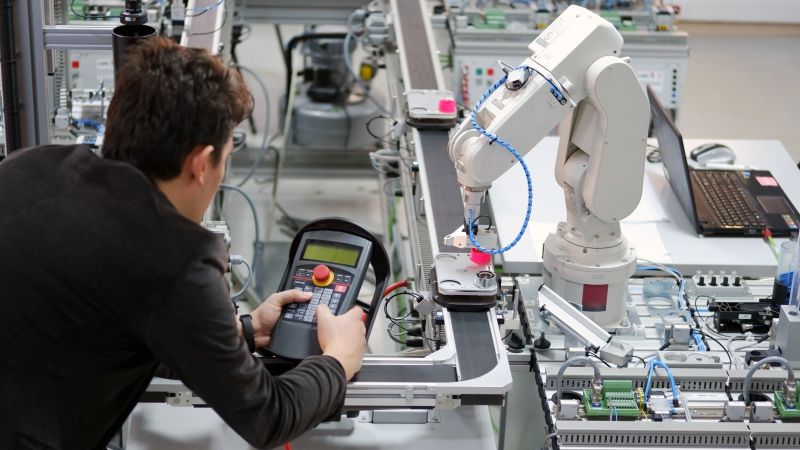
The 20 mm encoders are suitable for space-constrained motion control applications, including medical instrumentation and robotics. Image used courtesy of Adobe Stock
Precise Motion Control
Compact encoders have many uses besides robotics. The small size and the high resolution of Posital’s new multiturn encoders make them suitable for high precision motion control. Medical devices, such as imaging systems, surgical robots, and various therapy equipment rely on precision motion control, and Posital expects its new compact encoders to perform in these roles as well as others.