Facebook
 Google
 GitHub
 Linkedin
RoboBees and Smart Tractors Advance Agri-Robotics Tech
From RoboBee to smart tractors, researchers unveil innovations in microrobotics and autonomous farming that boost precision, safety, and sustainability.
Researchers from the Harvard Microrobotics Laboratory (HML) detail the recent advancements in the safe and damage-mitigating landing of their innovative, articulated robotic bee. Other research provides a novel navigation method for a soft-fruit-picking robot that enhances the productivity of automated robotics in farming environments. Cross-industry collaboration has also sparked the creation of an innovative autonomous tractor that is intended to improve vehicle stability, operational accuracy, and vehicle part longevity.
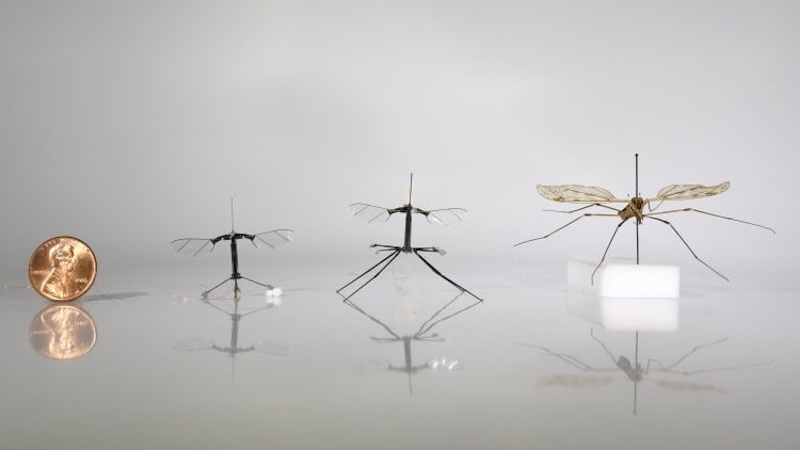
An image showing the current version of RoboBee (next to the coin) and previous iterations alongside a crane fly specimen. Image used courtesy of Science.org
RoboBee
HML scientists have published recent progress in updating the articulated legs and controller of their aerial micro robot, RoboBee. The improvements are intended to facilitate a safe and damage-free landing, protecting the delicate robotic structure, including its piezoelectric actuators.
The little bee is based on the biological anatomy of the crane fly, with ultra-thin segmented legs and a fine pair of wings. The RoboBee’s wingspan measures a total of three centimeters, and while light and delicate, previous iterations have generated enough of a ground effect with air vortices to hinder a smooth landing. This is why the latest iteration of RoboBee sports an upgraded controller. This ensures that the RoboBee lands with a tad bit more grace, enough to facilitate landing in natural environments, such as in a forest on a leaf or tree trunk, which is a short-term goal of the research team behind the innovation. Before this step, the researchers would have to turn off the RoboBee just above the ground, so it would simply drop and land.
A brief overview of the RoboBee project provided by PhD student and co-author of the study, Christian Chan. Video used courtesy of Harvard John A. Paulson School of Engineering and Applied Sciences
The piezoelectric actuators mimic striated muscles found in living insects and are used to control the movement of legs, wings, and other body parts. The piezoelectric actuators allow for more fine-grained control, using the direct effect of mechanical stress (pressure) to voltage generation and the inverse effect of this for facilitating movement of the body of RoboBee.
The researchers took great care in developing the legs of the RoboBee, turning to specimen records of insects from the Harvard Museum of Comparative Zoology database and fine-tuning prototypes for the appropriate stiffness and level of dampening for each joint. The two-joint compliant leg design incorporates materials including Kapton (a lightweight and durable polyamide film), carbon fiber, adhesive, and TPE (or a rubber-like thermoplastic elastomer).
The catalytic effect of this research is likely to impact further research into biomechanics for robotics, artificial pollination, disaster surveillance, and environmental monitoring. The next step for the researchers is to incorporate onboard electronics to support the prized trinity of automated functioning, sensors, control, and power.
Robotics for Enhanced Vertical Agronomy
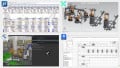
The challenge of maneuvering a small agricultural robot across high-bed crop rows—where space is limited, the terrain is uneven, and conventional sensors are challenging to install—is the focus of Professor Takuya Fujinaga’s work. The robot is entirely dependent on a LiDAR (light detection and ranging) sensor, which creates a 3D image of the environment by scanning it by reflecting laser beams off surrounding surfaces. Reliable navigation is difficult because the beds have few distinguishing features and are lined with shifting plastic mulch sheets. To get around this, the robot continuously modifies its trajectory and position from the beds using real-time feedback. It maintains its course even as the surroundings change from wind disturbance and other factors.
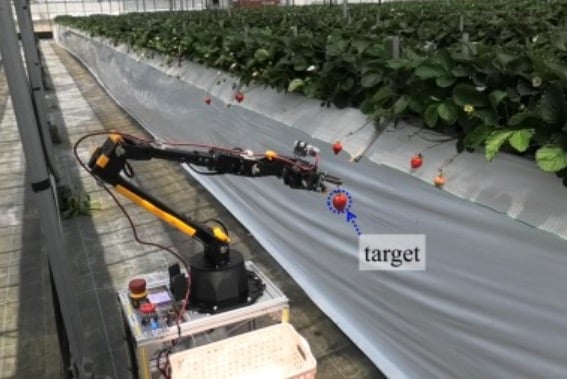
A small agricultural robot navigating high-bed cultivation areas and harvesting strawberries. Image used courtesy of Science Direct
Assistant Professor from Osaka Metropolitan University, Takuya Fujinaga, has developed a productivity-enhancing algorithm that allows agricultural robots to navigate cultivation beds and reach allocated target destinations without prior path planning. Prof Fujinaga confirmed the success of his navigation method through virtual simulation and highlighted the importance of using this cost-effective tool for finessing navigation algorithms and choosing sensors before real-world deployment.
A Unique Autonomous Tractor Design
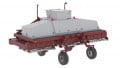
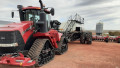
In other autonomous agricultural news, University of Córdoba researchers have created a novel tractor design that is distinct from any other available on the market due to its steerable wheels and self-leveling axles.
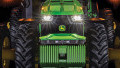
The fully autonomous John Deere 8R tractor uses a fusion of GPS, cameras, and artificial intelligence for navigation and obstacle detection. Unlike the Córdoba tractor, the 8R is more suited to level ground and open fields. It is not as adaptable when it comes to navigating space-limited areas or more rugged/uneven terrain.
While exhibiting the capabilities of traditional and modern autonomous tractors, the Córdoba tractor features hybrid steering and independent self-levelling axles, which improve traction when traversing harsh terrain in demanding agricultural settings like olive groves, vineyards, and orchards. These axles lessen the chance of the tractor toppling over on slopes or uneven ground by continually adapting to undulations in terrain. Additionally, this stability increases the precision of onboard sensors like GPS and LiDAR, enhancing the accuracy of navigating paths through farming land. Furthermore, regular leveling guarantees that farming tools keep the right amount of contact with the soil, improving the efficiency of operations like spraying and harvesting.
The tractor also employs LiDAR technology with two LiDAR-based sensors incorporated into the front and rear of the vehicle, and operators can control the vehicle from multiple mobile platforms.
Continued Evolution
Taken together, the technologies featured here are a view into the ever-evolving world of microrobotics and autonomous agricultural machinery, the likes of which are set to expand biomechanical research, the productive capacity of farms, and the efficiency of farming workflows.