Facebook
 Google
 GitHub
 Linkedin
SMC Updates Valve Manifold and Rotary Actuator Series
SMC has updated its existing CRB rotary actuator series to include double vane types. The company’s JSY1000-E valve manifold series has also been updated to include new features and added protocol compatibility.
For many years, SMC Corporation has been a leader in industrial pneumatic devices and fittings that are commonly used in the automation industry. SMC continues to advance its solutions by incorporating new technology into existing product lines. Recently, SMC added to its valve manifold line and its rotary actuator line.
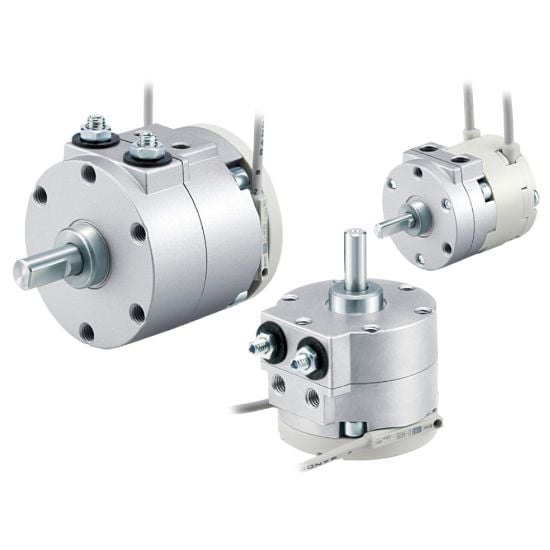
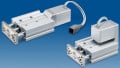
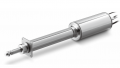
SMC’s CRB rotary actuators are now available as a double vane type. Image used courtesy of SMC Corporation
CRB Rotary Actuators
A rotary actuator is similar to a linear actuator — only the motion is rotary instead of linear. There are two ports, and pressurizing one will drive the actuator in one direction while the other port will drive it back. SMC’s CRB series of rotary actuators come in five different sizes, offering different port pressure ratings and port sizes. Different models can be selected, including without an auto switch, with a vertical auto switch, with an angle adjustment unit, and with a vertical auto switch and an angle adjustment.
Now, the CRB series has received more torque thanks to the double vane option. A double vane rotary actuator can deliver more rotating torque because of the second vane within the housing. The double vane, however, comes at a cost with a higher weight, sometimes a larger body, and a reduction in rotating angle selections.
The double vane is available in all the CRB models and has a rotating angle of 90° or 100°. The available sizes for the double vane option range from 10 to 40, with the size 10 having the lowest operating pressure and the size 40 having the largest operating pressure. The CDRB, which is a rotary actuator with a standard auto switch, is not available with a double vane.

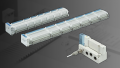
SMC’s JSY1000-E series of valve manifolds is now available with a spacer type ejector and vacuum release flow control unit. Image used courtesy of SMC Corporation
JSY1000-E Valve Manifold
Pneumatic valves are used to direct the flow of compressed air to different areas of the pneumatic system. A manifold contains multiple valves in a densely packed container. Some applications require vacuum and actuator control — SMC’s JSY1000-E series makes that process easy with valves that are capable of both actuation and vacuum.
One of the new features added to the JSY1000-E is a spacer-type ejector that has a built-in silencer. The ejector breaks the vacuum suction with a puff of compressed air, and having a silencer reduces overall noise.
The ejected air flow is important in some applications where too much flow might disturb the parts that were just placed. Typically, an inline flow control is used to manage the flow of the ejector. SMC has added a vacuum release flow adjustment unit that fits directly underneath the ejector valve on the JSY1000-E.
Fieldbus communication has become a standard requirement for most automation devices. The JSY1000-E has also recently taken on three protocols: IO-Link, ProfiNet, and EtherNet/IP. These protocols have become an unofficial standard in the industrial automation world.
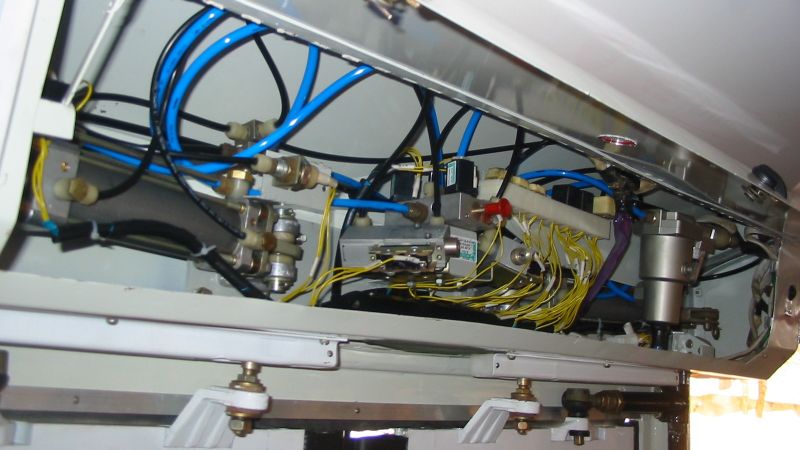
A pneumatic system used on a trolleybus. Image used courtesy of Wikimedia Commons
Pneumatic Advancements
Pneumatic devices are an economical way of moving, pressing, and rotating tooling. The latest additions to the SMC product portfolio demonstrate the company’s continual investment in enhancing existing components to meet customer needs better.