Facebook
 Google
 GitHub
 Linkedin
Soft Landings, Hard Results: SMC’s new ZP3B_M Magnet Buffer
Magnetic buffers, such as the SMC's ZP3B_M series, outperform spring buffers in automation due to consistent force, cleanliness, and longevity.
In the realm of automation, especially applications involving delicate or easily damaged workpieces, the impact force applied during handling can be a significant concern that commonly gets overlooked. Traditional buffering methods, such as relying on springs, often generate particles due to friction and may not provide consistent cushioning for workpieces of varying heights. This can lead to production inefficiencies and increased defect rates. SMC recently introduced the ZP3B_M Series Magnet Buffer, potentially offering a solution to the challenges by incorporating a spring-less design. This buffer provides a stable and consistent reaction force throughout the stroke. Its unique design also minimizes particle generation, making it ideal for various automation applications.

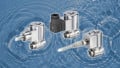
SMC’s newly released ZP3B_M Series Magnet Buffer offers stabilization without springs. Image used courtesy of SMC
Magnets Vs. Springs: Reaction Force
Buffering systems are used to absorb impact forces, ensuring consistent handling and preventing costly errors in automated applications. Traditional springs and newfound magnetic solutions dominate this space. Spring-based buffers rely on the principle of compression. As a force is applied, the spring compresses, generating a counterforce that resists the impact. However, a key characteristic of springs is that the reaction force increases drastically as the stroke length (the amount of compression) increases. This is a fundamental property of springs: the more they are compressed, the more force they exert. While spring buffers may offer a lower initial cost, this fluctuating force can be problematic for processes demanding consistent cushioning.

A table to show the differences in buffer reaction forces as the buffer stroke increases. Image used courtesy of SMC
Magnetic buffers offer a distinct advantage in terms of consistent reaction force. By utilizing the principle of magnetic repulsion, these buffers, like SMC’s ZP3B_M series, maintain a relatively constant reaction force even as the stroke length increases. The 4-pole magnet design in the ZP3B_M series contributes to this stability. This near-linear relationship between stroke and force allows for more predictable and reliable handling.
Engineers in industries that require a clean environment, such as the semiconductor sector, benefit from the low particle generation characteristic of magnetic buffers. Unlike traditional spring mechanisms, which experience significant friction, a spring-less structure incurs less wear and tear. Many people overlook the implications of this wear and tear, especially in industries like food production. If an engineer uses a spring mechanism in such applications, wear particles may inadvertently end up in food products. This could lead to serious consequences for both the consumer and the engineer when it's time for troubleshooting and diagnosis.
Magnets Vs. Springs: Application
Consider an automated system designed to pick and place glass panels with a width tolerance of ±6 mm onto a conveyor belt for further processing. If this system utilizes traditional spring-based buffers, the varying heights of the glass panels could lead to inconsistent cushioning. Thicker panels may compress the springs more, resulting in a stronger and potentially damaging impact, while thinner panels might receive less cushioning, also risking damage.
According to the table (buffer stroke vs. buffer reaction force), this ±6 mm variance would pose no problem for pick and place operations with the utilization of the magnetic buffer. SMC offers a variation of the ZP3B_M series with a 16 mm stroke, which would enable consistent reaction forces regardless of the panel heights within this hypothetical scenario. The magnetic buffer would allow for consistent handling, therefore improving the quality of the process and the overall productivity of the automated system.
The Magnetic Edge
For engineers facing the challenges of delicate workpiece handling, magnetic buffers offer a clear advantage. SMC's ZP3B_M series exemplifies the benefits of consistent force, minimal particle generation, and extended lifespan. While initial costs may be a consideration, the long-term gains in efficiency and reliability make magnetic buffers a compelling choice for optimizing automated processes.