Facebook
 Google
 GitHub
 Linkedin
Sonair Invigorates AMR Perception with 3D Ultrasonic Tech: ADAR
Sonair debuts a pioneering sensor tech, ADAR: a first-of-its-kind, three-dimensional ultrasonic technology that challenges the capabilities of conventional LiDAR perception.
Sonair steps out of stealth mode to bring industrial automation and robotics businesses a game-changing technology, moving away from light detection and ranging (on which LiDAR relies) to using sound waves to detect/avoid objects. The novel technology, ADAR (acoustic detection and ranging), is intended to deliver safe navigation of autonomous mobile robots (AMRs) and vehicles while lowering integration costs and reducing power consumption.
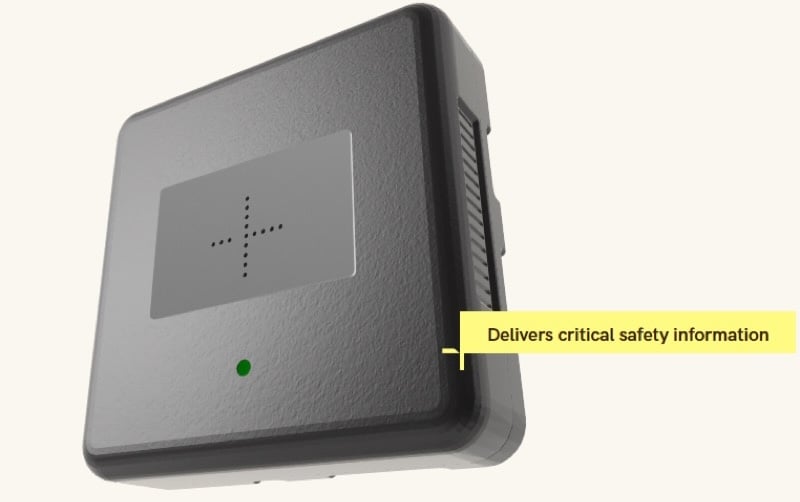
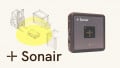
A 3D, ultrasonic sensor weighing under 100 g provides users with a range precision of 2 cm and a max power consumption of 5 W.
LiDAR
LiDAR systems for AMR systems, for example, empoy a near-infrared emitting laser, laser source, scanner for laser projection, a receiver to pick up reflected laser beams, global positioning system (GPS), inertial measurement uni (IMU), and a processing unit which compiles camera and laser data to map the robot’s surroundings. With LiDAR, processing units can require significant power to generate accurate results (which also means greater energy consumption), and this, combined with other components in a LiDAR-based navigation system, can use up a lot of space.
ADAR
The ADAR sensor sends out bursts of ultrasound (not electromagnetic waves as with LiDAR). It combines feedback (via an array of sensors) with 2D images and artificial intelligence (AI) to detect objects (and the distance of those objects in relation to robots) via a 180 by 180 field of view (with a range of up to 5 meters). The ADAR sensor is compact with an angular precision of 2° (center) - 10° (edge), an ultrasonic frequency of 70-85 kHz, and an operating temperature of -10 to +50 Celsius.
Sonair owns the design of the micro-electro-mechanical system (MEMS) transducers with integrated piezoelectric actuation. The transducers measure a millimeter in size and are produced by SINTEF MiNaLab. These transducers can be organized in an array with a separation distance corresponding to half an ultrasound pulse wavelength.
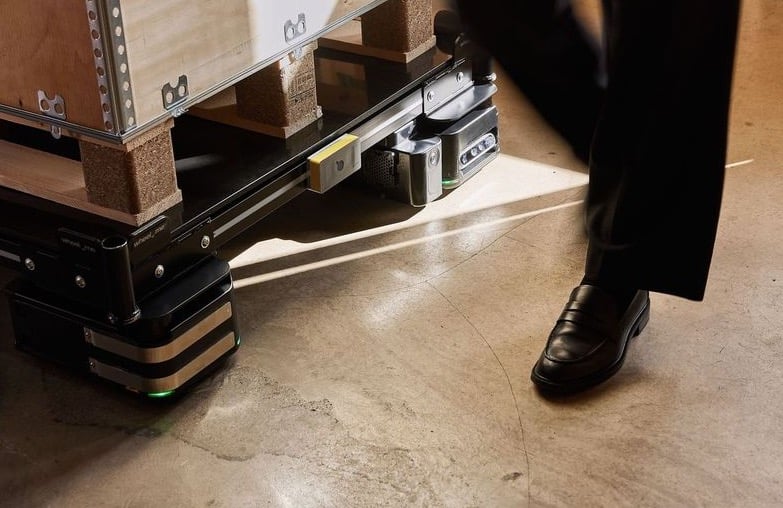
The compact sensor provides safety and control to AMRs in many industrial environments.
Beamforming is a method for directing and focusing radio waves or sound to produce images or identify objects. It is a crucial piece of technology that powers devices like medical ultrasonography, RADAR, and SONAR.
Sonair's invention combines sophisticated algorithms for object recognition and beamforming with specifically adjusted sound sensors. This enables it to simply emit sound waves and respond to the echoes in order to record comprehensive 3D info. Sensor systems can account for more than 30% of the hardware cost of a robot. Sonair says that by implementing the ADAR sensor, customers can cut that cost by 50-80%.
The design of the ADAR system stems from innovative, patented research from an independent research institution, SINTEF, based in Norway.
Going Forward
Following the achievement of receiving the “Best of Sensors 2024 Award,” Sonair signed up over 20 test partners (automotive technology supply, industrial manufacturing conglomerates, and AMR producers) and procured low-key validation of the ADAR sensor as part of the Early Access Program. The company has received commercial orders, including one from a top-tier Swiss manufacturer of autonomous cleaning robots and one from Fuji Corporation for use in a new line of AMRs.
The Sonair team aims to develop their ADAR sensor further by including feedback from test partners, including the obtainment of performance level d safety certification in line with ISO13849:2023 (by the end of 2025).
At Automate 2025, May 12-15th, event attendees can get up close and personal with ADAR technology.
All images used courtesy of Sonair
Related Content