Facebook
 Google
 GitHub
 Linkedin
The Omron M1 Inverter: Scalable AC Motor Control With Integrated Safety
Omron Automation’s M1 Inverter family targets general AC motor control applications, providing a flexible VFD solution with support for integrated safety and industrial protocols.
Component selection is critical for original equipment manufacturers (OEMs). To avoid reinventing the wheel on every project, OEMs often prioritize versatile components that support a wide range of applications.
Omron Automation recently announced the expansion of its motion portfolio with the M1 Inverter series. Designed for modular AC motor control, the M1 family supports multiple industrial protocols, integrated safety, and native integration with the Omron Sysmac automation platform.
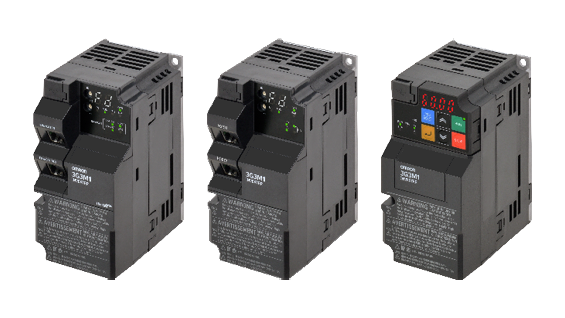
Omron has designed its M1 VFDs for scalable AC motor control. Image courtesy of Omron Automation
The M1 Inverter Family
Designed with OEMs in mind, the M1 Inverter series comprises full-featured VFDs that control torque, position, and speed for supported AC motors. The M1 portfolio is available in three communication variants: built-in EtherCAT, standard RS-485, and built-in Ethernet, which supports PROFINET, EtherNet/IP, and Modbus TCP.
All three variants support single-phase 200 VAC and three-phase 200 VAC to 400 VAC, with power ratings of 0.1 kW to 3.7 kW for single-phase and 0.1 kW to 22 kW for three-phase models. The entire M1 family uses integrated safety via STO signals or over a communication protocol and is SIL 3 rated.
To measure position, each M1 VFD includes a port for either an ABZ or 1CH encoder. The various options offered on the M1 platform make it suitable for an OEM that has varying projects with a variety of different motion control applications. Each VFD can be controlled the same way regardless of motor power.
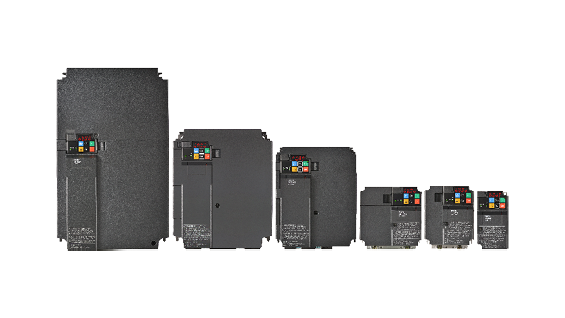
The Omron M1 Inverter family offers a wide range of hardware variants supporting diverse power capacities and industrial communication protocols. Image courtesy of Unsplash
Communications and Integration
Devices like VFDs often have many parameters that need to be configured to support the connected motor and optional devices. By standardizing on a single VFD platform, integrators can reuse existing code and starting parameters across projects, reducing integration time.
VFDs are often programmed using the front panel interface, requiring an intimate knowledge of the parameter names as well as how to navigate the menu. The M1, however, integrates directly with Omron’s Sysmac automation software, the same software used to program Omron Sysmac PLCs. The Sysmac software provides a user interface to set controls and parameters dynamically, all in the same software used to program the control device.

An industrial pumping application with a large AC motor driving the pump. Image courtesy of Unsplash
Motion Control With Feedback
Not all VFDs provide positional feedback; most receive a frequency setting to drive the overall speed. The M1 series of VFDs accepts encoders to provide a closed-loop system, thus allowing for positional feedback to the control system.
In pumping applications, motor speed dictates the volume of product being pumped. If you know how fast your motor is moving, you can calculate how much product has been pumped into a vessel.
Dial tables are often used in assembly automation to provide a compact platform for station-based assembly, but servo motors are typically the motor of choice because they can detect position. With an M1 VFD and an external encoder, the table position can be easily reported back to the control system.
Selecting a device flexible enough to work across many applications can be challenging. Omron’s new M1 VFD makes that task easier by offering a VFD that can support varying motor sizes as well as different communication protocols, making it an excellent choice for machine builders.