Facebook
 Google
 GitHub
 Linkedin
Turck Expands Sensing and Automation Solutions With Latest Hardware
Turck continues to push the boundaries of what is possible in automation technology with its latest hardware, including radar distance sensors, signal amplifiers, HMI/PLCs, and enhanced EtherNet/IP Encoders.
Turck has been developing automation solutions since 1960. Beginning in a shed and expanding to a global presence, Turck has focused on developing non-contact sensors and system hardware to make manufacturing and transportation industries more efficient. Here are a few of the company’s latest products.
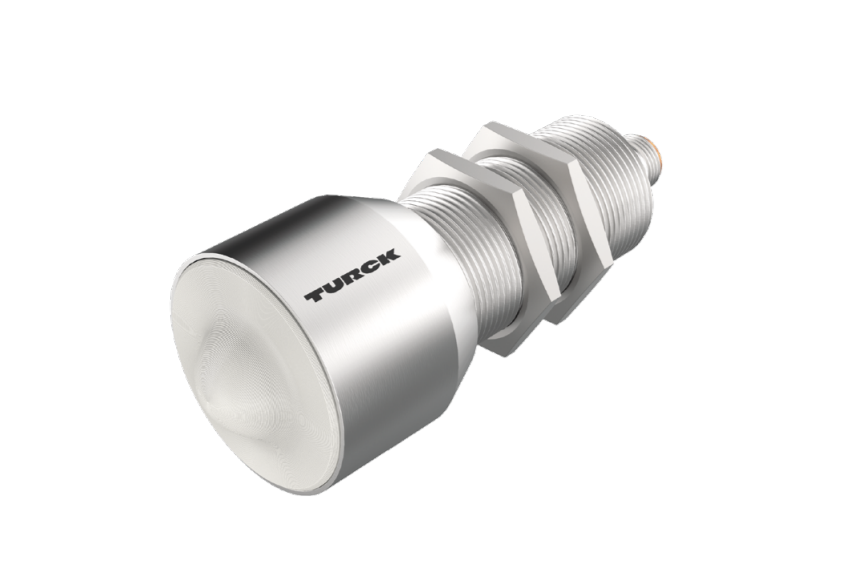
Turck’s DR series radar distance sensor, built for harsh environments. Image used courtesy of Turck
DR Series Radar Distance Sensors
Turck has developed a new set of radar distance sensors, the DR series, that can detect objects up to 15 m away. These sensors are designed for port and transportation industry applications, such as in-crane sensing for moving intermodal shipping containers. As such, the IP69K-rated sensors have been built to withstand all that is demanded in these environments, such as high shock tolerance (100 g) and high resistance to salt spray corrosion.
The main advantage of these sensors is that they use radio frequency (RF) to detect objects. In port applications and many other harsh environments, there is too much background noise and changing light conditions to use either ultrasound or light (LIDAR), as many other distance sensors use. The RF is transmitted at 122 GHz and can detect obstructions or accurately find the distance between the crane and the container.
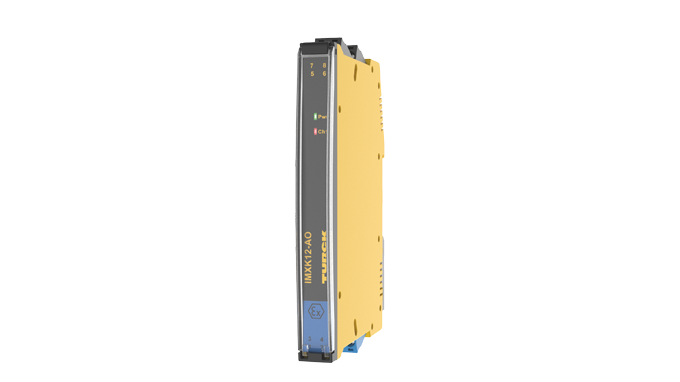
The IMXK12 is ready for deployment in explosive environments. Image used courtesy of Turck
IMXK12 In-Cabinet Interface Amplifier
Often, signals need amplification, which requires more external power. However, simply placing a traditional amplifier in a hazardous environment, especially one with hazardous vapors present, is a major safety risk.
The IMXK12 single signal amplifier is designed to fit in narrow cabinets, located in hazardous environments. Designed intrinsically safe to Zone 0, the IMXK12 can be placed in areas where explosive vapors are present, such as in refineries, chemical manufacturing plants, and other such locations. The Zone 0 designation indicates that the device can be in an explosive environment for more than 1000 hours a year, meaning it is suitable for permanent installation. With only a 77 mm depth, it will fit in small electronic cabinets.
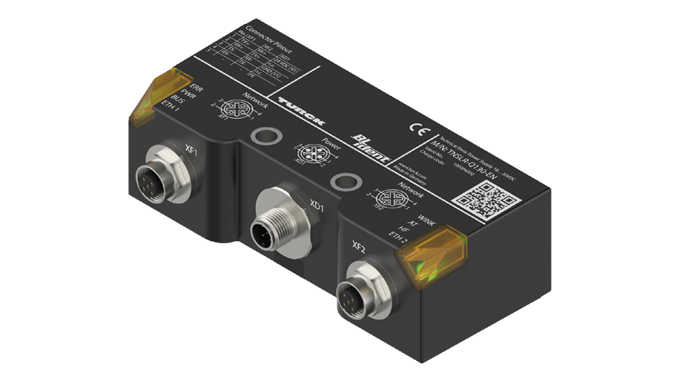
The Q130 HF read/write head is capable of programming RFID tags or reading them. Image used courtesy of Turck
Q130 HF Read/Write Head
Radio Frequency IDentification (RFID) makes tracking products and parts simple. Rather than requiring a routing sheet for each part during manufacturing or having to scan a barcode, RFID can be used to track the product automatically.
In order for RFID tracking to be performed efficiently, a reader and writer must be readily available. Turck's Q130 HF read/write head can perform these operations quickly, particularly for one-point scanning operations. Designed to meet the challenges in modern industry, the Q130 can withstand harsh environments with its IP67 and IP69K ratings. Furthermore, it can be integrated into existing automation systems, connected as a PROFINET device, capable of running EtherNet I/P, or communicating as a ModBus TCP Slave.
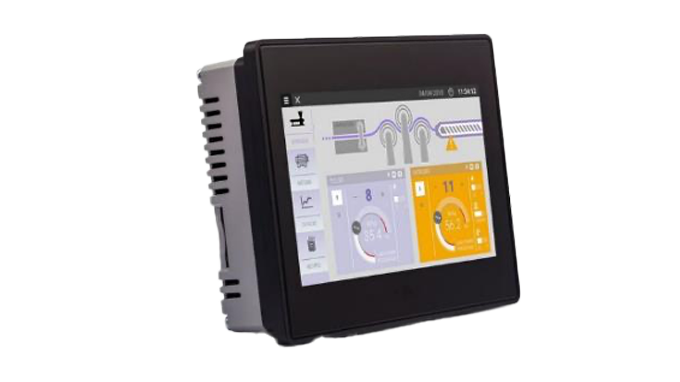
The TX800 HMI/PLC developed for IIoT applications. Image used courtesy of Turck
TX800 HMI/PLCs and Edge Controllers
The new TX800 series of HMI/PLCs and edge controllers joins an existing catalog of powerful controllers that can be used to make intuitive HMIs for monitoring and controlling process equipment. With quad cores, the TX800 is capable of performing calculations and process operations quickly, while being accessible via a programmable HMI.
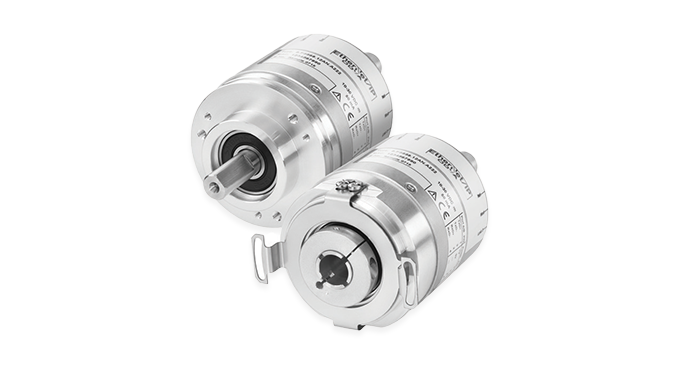
Turck has updated its EtherNet/IP encoders with enhanced functionalities. Image used courtesy of Turck
EtherNet/IP Encoders
Turck also makes several models of electrical encoders, used for measuring rotational position, speed, and acceleration. These encoders are often paired with electric motors to ensure that they are turning at the correct speed or positioning stages, pulleys, and other components at their proper place for the task at hand.
Single and multiturn encoders (RM105/106 and RS107/108, respectively) have been ruggedized for the industrial environment. They are rated to IP 65/67, can operate in temperatures from -40 F to 176 °F, and can withstand up to 10 g of vibration before failure. Each encoder is Ethernet-ready, making it suitable for integration with other existing automation hardware.
Related Content