Facebook
 Google
 GitHub
 Linkedin
Who Shrunk the Servo Drive? B&R’s ACOPOS P3 Cuts Size, not Power
B&R expands its ACOPOS P3 servo drive line with higher power density, faster control loops, and up to 50% less cabinet space.
Control cabinets are usually already crowded because we tend to get the cabinet just big enough to support our needs. Yet, demands for higher precision and faster throughput continue to rise across industries like plastics, printing, and metalworking. Engineers face a tough trade-off: either expand cabinets to fit additional hardware or accept limits on machine performance.
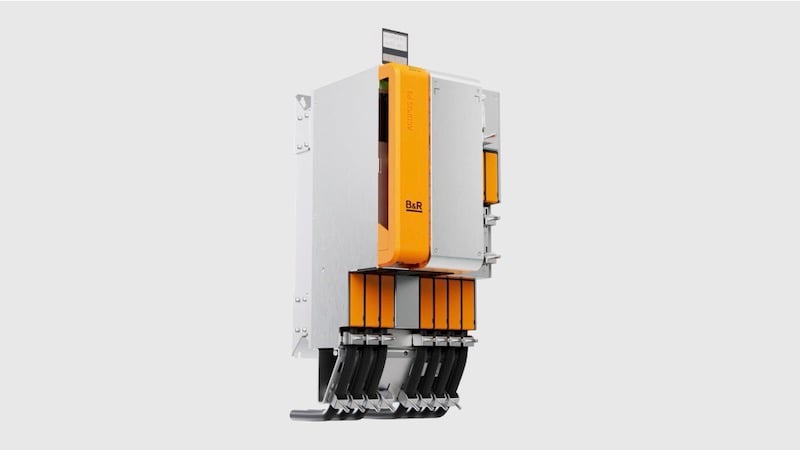
ACOPOS P3 modules provide higher power density and cut cabinet space requirements in half. Image used courtesy of B&R Automation
B&R Automation has recently expanded the ACOPOS P3 servo drive family, with the latest versions doubling power density in some configurations and raising computing power by eight times, all while keeping the same compact frame. Cabinet space requirements can be reduced by up to 50 percent, giving OEMs a way to deliver higher performance without enlarging control enclosures. This combination of greater processing power, wider power range, and smaller footprint is designed to help machine builders push their systems further without a major redesign of their cabinet layouts.
Higher Power, Faster Control
The upgraded ACOPOS P3 now supports power outputs ranging from 1 kW to as much as 80 kW. Seven new modules have been added, including single- and dual-axis versions. The two-axis option can deliver up to 64 kW per axis in one housing, effectively doubling the power density compared to earlier models. That makes it easier for engineers to design compact, modular machine concepts without sacrificing power.
In addition to the expanded range, control performance has also been improved. The drives now achieve a 50-microsecond cycle time for all position and speed loops. That responsiveness matters in industries where motion precision directly impacts product quality, such as high-speed printing, cam profiles in plastics machinery, or resonance-heavy textile systems. By executing intelligent control functions directly inside the drive, the ACOPOS P3 avoids delays associated with network communication or PLC bottlenecks. This helps machines run faster and with more stability, which translates into greater productivity and consistency on the shop floor.
Intelligent Features Built In
The upgraded drives incorporate increased computing power, model-based control, and integrated virtual sensors. These functions support vibration and resonance damping at the hardware level. The system enables stable motion profiles that maintain accuracy and product quality for industries such as paper transport or thin-sheet metal cutting.
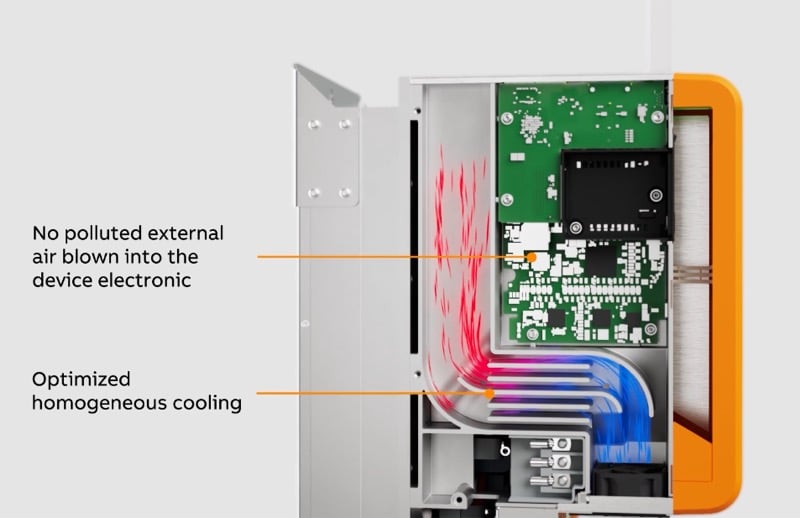
The drives now have a redesigned airflow system that directs dust away from sensitive components. Image used courtesy of B&R Automation
Reliability has also been strengthened with improvements to thermal design and a redesigned airflow system that directs dust and other particles away from sensitive components. At the same time, protective coatings on PCBs provide further resilience in harsh environments. Seventeen integrated temperature sensors allow the system to operate safely near its performance limits. This monitoring reduces the need for costly oversizing, since the drives can be used closer to their full rated performance without overheating or reliability concerns.
Cooling Flexibility and Global Use
B&R has built in multiple cooling options to fit different installation needs. Wall mounting allows smaller systems to dissipate heat through cabinet air, while pass-through mounting uses an external heat sink to move thermal loads outside the cabinet. For larger or higher-power setups, cold plate cooling transfers up to 60 percent of generated heat into a machine’s liquid cooling system.
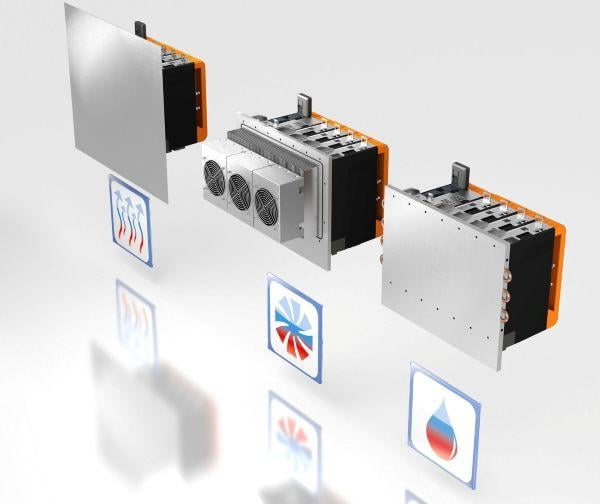
ACOPOS P3 supports pass-through or cold plate cooling, which can reduce cabinet size and minimize the need for additional cooling equipment. Image used courtesy of B&R Automation
The upgraded ACOPOS P3 is designed to work with all common power supply systems, eliminating the need for regional redesigns or extra components. For OEMs serving multiple markets, that reduces complexity and shortens development time, while simplifying inventory and support.
Compact Machines, Broader Choices
The expansion of the ACOPOS P3 family has created a broad portfolio that covers power needs from 0.7 kW to 80 kW. Instead of mixing and matching multiple product lines, machine builders can now standardize on one family of servo drives across low, mid, and high-power applications. Combining multiple axes in a single housing reduces wiring complexity and simplifies cabinet layouts, helping engineers build modular machines that are easier to scale.
For OEMs working in competitive industries, this means shorter time-to-market, lower build costs, and machines that deliver more performance per square inch of cabinet space. This could translate to faster printing lines, more responsive textile machines, or plastics systems that can run longer without downtime. The ACOPOS P3 can help engineers develop powerful and efficient machines.
Machine builders are constantly asked to deliver higher performance in smaller spaces, and control cabinet real estate is at a premium. With its expanded ACOPOS P3 family, these servo drives combine higher power density, faster control loops, and smarter features in the same footprint. The result is a drive system that helps manufacturers design more compact, reliable, and productive machines without compromising performance.
Related Content