Facebook
 Google
 GitHub
 Linkedin
Facts Behind the Shock! Investigating the Dangers of Arc Flash
Even though electrical safety practices have existed for over a century, arc flash safety has only gained traction in recent decades. This article discusses the danger and prevention of arc flash injury.
It is evident that workplace hazards are present everywhere, leading to the gradual development of safety standards over time, often in response to incidents. While the concepts of electrical design, preventative maintenance, and repair have been around for centuries, arc flash safety has only gained momentum in the last two decades.
In this article, we will discuss what arc flash is, how it occurs, current regulations, and the personal protective equipment (PPE) used in the industry.
Even though this article does not serve as a suitable replacement for formal safety training, it is important to have a general understanding of the potential hazards that an operator or engineer may face in their respective industries.
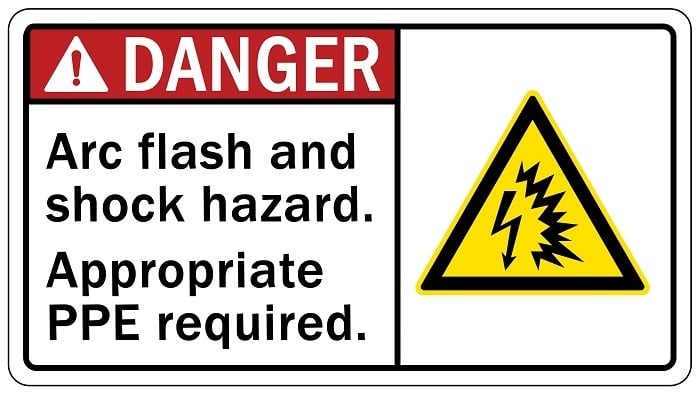
Figure 1. An example of a placard for arc flash hazards. Image used courtesy of Adobe Stock
What is an Arc Flash?
For those unfamiliar with the concept of arc flash, this hazard occurs when an electrical fault allows current to flow through the air between two phases or between a phase and ground. This fault results in the release of energy, which can range from a brief spark of light to a destructive explosion, emitting blinding light, heat, and molten debris.
An arc flash event has the potential to cause irreparable damage to machinery or buildings and can be instantly fatal to individuals. In extreme cases, the temperature of the arc flash can exceed 30,000°F, far surpassing the surface temperature of the sun (about 10,000°F).
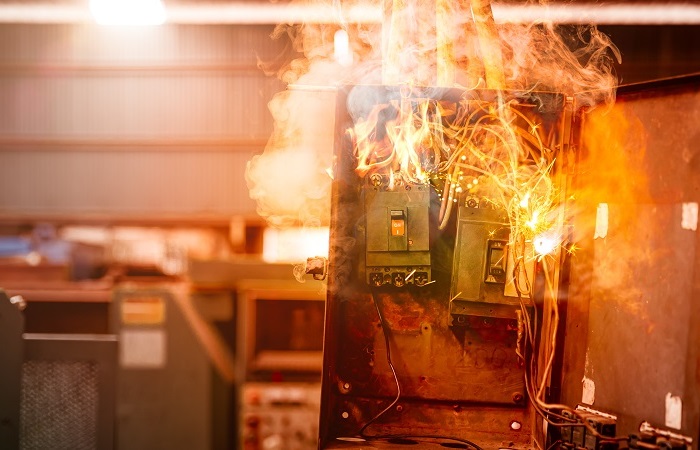
Figure 2. Fire hazard inside an electrical cabinet, although arc flash can be far more explosive than this example. Image used courtesy of Adobe Stock
Now that we have the “textbook definition” of arc flash, let’s discuss a few examples of how an arc flash can occur for a better understanding.
In today’s safety-conscious world, arc flash is rare, but still possible for accidents to occur. For example, when inspecting a control cabinet, a technician may accidentally drop a lead from a multimeter, resulting in an arc between phases. In industries with harsh conditions such as dust, debris, or gas buildup, unintentional arcs can occur, allowing current to jump between phases or to ground. While accidents will still happen to occur, it is possible to prevent most incidents from occurring through proper training.
Arc Flash Regulations and Conformity
When speaking of electrical safety, three main entities cover electrical safety within the workplace; the National Fire Protection Association (NFPA), the Occupational Safety and Health Administration (OSHA), and the Institute of Electrical and Electronics Engineers (IEEE). Between these three governing entities, a series of regulations have been developed to minimize the chances of occurrences of arc flash ranging from personal protective equipment, warning labels, and common work practices.
Regulations
- NFPA 70E
- It’s virtually guaranteed that, when going through arc flash training, this regulation will be mentioned. NFPA 70E is the golden standard when it comes to reducing the risk of a variety of electrical mishaps, including arc flash, when working on energized systems.
- OSHA Standards 29 CFR Part 1910.333 & 1910.335
- These regulations have created standard work practices and safeguards for personal protective equipment (PPE), but directly reference NFPA 70E.
- NFPA Standard 70
- The National Electrical Code is a living document that covers a wide variety of standard practices for installing, removing, operating, and labeling electrical components.
- IEEE 1584
- The following regulation pertains to the calculation of arc flash hazards for operating voltages exceeding 208 V up to 15,000V or 700 A to 106 kA systems and excludes single-phase or direct current (DC) systems. This method of calculation establishes the minimum PPE level necessary when conducting work on an electrical system.
Arc Flash Training and Equipment
Individuals exposed to electrical hazards need to receive training from their employers. This training should occur at least once every one to three years, or more frequently if mandated by the employer. Usually, companies tend to subcontract their training needs to specialized firms like Eaton, a prominent player in the power management industry. Eaton offers comprehensive arc flash training covering a wide array of topics, including the hazards associated with arc flash, appropriate personal protective equipment (PPE) and gear, and methods for preventing electrical hazards.
As for the personal protective equipment, we’ll be referencing what is known as incidence energy, which is essentially the amount of energy released from an energy source.
To provide some tangible point of reference, when the incident energy exceeds 1.2 Cal/cm² a second-degree burn can occur when a person is exposed for longer than 1 second. For PPE, this incidence energy is how the equipment will be rated and is separated into four categories based on the minimum arc rating and is specified in NFPA 70E. For example, listed below are the types of equipment needed at PPE Category 1 compared to the PPE required at Category 4 arc rating.
Category 1. Required PPE for a Minimum arc rating of 4 Cal/cm²
Required:
- Long sleeve shirt and pants with a minimum incident energy rating of 4 Cal/cm²
- Note the long-sleeved shirt and pants can be replaced with a jacket or coveralls as long as they carry the appropriate arc rating.
- Face shield or arc flash suit hood
- Hard hat
- Eye protection
- Hearing protection
- Heavy-duty leather gloves
As needed:
- Arc-rated jacket (jacket, parka, or other rainwear)
- Hard hat liner
- Leather footwear
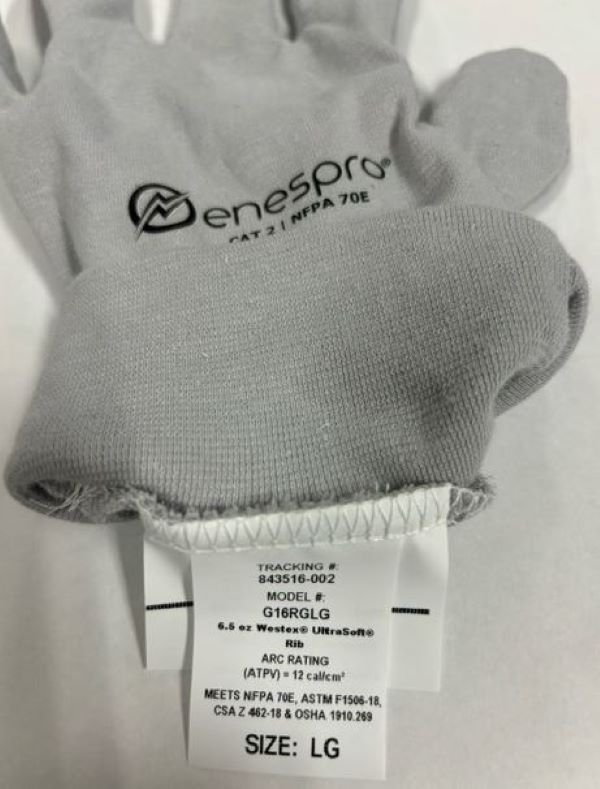
Figure 3. This image depicts the arc rating on the label of issued gloves (ATPV = 12 cal/cm2). Image used courtesy of the author
Category 4. Required PPE for a Minimum arc rating of 40 Cal/cm²
Required:
- Arc-rated flash suit jacket and arc-rated pants rated to 40 Cal/cm²
- Can be substituted for arc-rated coveralls.
- Arc-rated flash suit hood rated to 40 Cal/cm²
- Rubber-insulated gloves with leather protectors.
- Can be substituted for arc-rated gloves rated to 40 Cal/cm²
- Hard hat
- Eye protection
- Hearing protection
- Leather footwear
As needed:
- Arc-rated jacket (jacket, parka, or other rainwear)
- Hard hat liner
Each article of PPE will be labeled with an Arc Thermal Performance Value (ATPV), a Class rating, or an Energy Break Open Threshold (EBT). These ratings are essentially a measure of the level of protection that the PPE can provide and determine the amount of heat energy the desired equipment can withstand before imminent danger to the user.
Insulated Electrical Tools
While this seems like common sense, there are some people out there who believe putting electrical tape on a screwdriver handle still qualifies as insulated. With NFPA 70E and OSHA requirements, the tools themselves must undergo testing to ensure they can handle voltages up to 10,000 VAC, be impact-resistant and flame retardant, and have the international 1000-volt rating symbol printed on the tool.
Although some people may see arc flash training as a hassle in their day-to-day work activities, the training, PPE, and other safeguarding are there to protect the individual. However, not all accidents can be avoided, but they can be minimized by wearing the right equipment and doing the right when interacting with equipment that is properly maintained. Ensure that you have been trained and understand the training because, at the end of the day, we all want to go home the same way we went to work.