Facebook
 Google
 GitHub
 Linkedin
The Science Behind Electromagnets: Induction and Coils
Have you ever disassembled a motor and wondered how it rotates? Throughout this article, we’ll discuss electromagnetic induction and how magnetic fields can be utilized to generate motion.
Everyone uses a wide range of technology daily, but we may not know exactly how the devices actually work. Let’s be honest.. Very few people really sit down and ask how their car starts, how a solenoid valve actuates, or even how an industrial motor creates motion.
In this article, we will discuss electromagnetic induction, which takes an electrical current, a magnetic field, and perhaps even some mystery magic to turn our hopes and dreams into physical motion.
The Faraday Experiment
The odds are that you use some type of electromagnetic induction technology on a daily basis. It is used in most electromechanical control systems, ranging from sensors to induction motors to transformers. With the invention of the electromagnet in 1825, electromagnetic induction was discovered by an experimentalist named Michael Faraday in 1831.
Faraday’s experiment, known as Faraday’s ring, used an iron ring with two wires wrapped around the opposite side of the ring. When Faraday introduced a current through one wire, a “wave” would travel through the ring and induce an “opposite” electrical effect in the wire on the other side. This took the concept of an electromagnet, then extended it one step further by using the magnetic field to produce current.
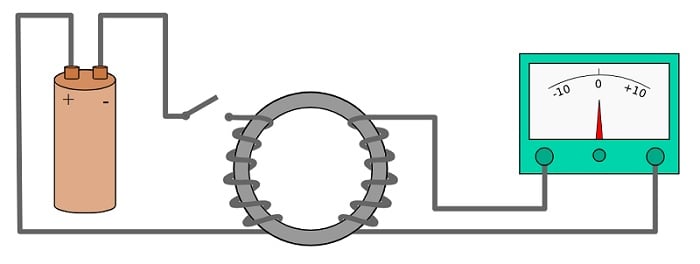
Figure 1. In Faraday’s experiment, a magnetic field was created and collapsed to produce a current in the opposite coil. Image used courtesy of InverseHypercube on Wikimedia
Creating the Electromagnetic Field
So what is a magnetic field, how is it created, and why is it essential for electromagnetic induction?
As a straightforward definition, a magnetic field is defined as the region surrounding a charged particle where it experiences a force due to magnetism. Magnetic fields are created by current moving through a conductor; in this experiment, it arises when a switch is activated to permit current to flow through a coil.
The resulting magnetic field manifests as forces characterized by both magnitude and direction but is considered static because the magnetic field remains constant over time; for more information on magnetic fields used in sensors, check out this interesting article from Control.com.

Figure 2. The field lines of a static electromagnet created by a wire coil. Image used courtesy of Adobe Stock
Electromagnetic Induction
For those who like definitions, electromagnetic induction creates an electromotive force (EMF) when the magnetic field is moved around a conductor. This sounds confusing, but electromagnetic induction is considered a complementary process to a magnetic field, but it is more dynamic rather than static.
If it is possible to use an electrical current to generate a magnetic field, it should be possible to produce an electric current from a moving magnetic field. To achieve this, the magnetic field has to change over time by moving, growing in size, or contracting. In Faraday’s experiment, he used a switch that would open and close, which would cause the magnetic field to expand and collapse, which is how his galvanometer could detect the changes in current.
Creating the EMF
The next question is this: “how we can generate motion with electromagnetic induction?”
We’ll use a simple induction motor as an example. Using alternating current, we perform the same process as Faraday's experiment. The alternating current will create a magnetic field that changes the polarity of each coil at regular intervals over an evenly spaced frequency. This makes magnetic fields of differentiating strengths, ultimately creating a magnetic force tangential to the rise and fall of the magnetic fields' strengths.
When partnered with a rotor containing permanent magnets, such as a squirrel cage, a rotational motion is created. Ferrous non-permanent magnetic rotors (called induction rotors) will also be influenced by the induction from the coils, but permanent magnet rotors are often more beneficial for variable-speed applications.
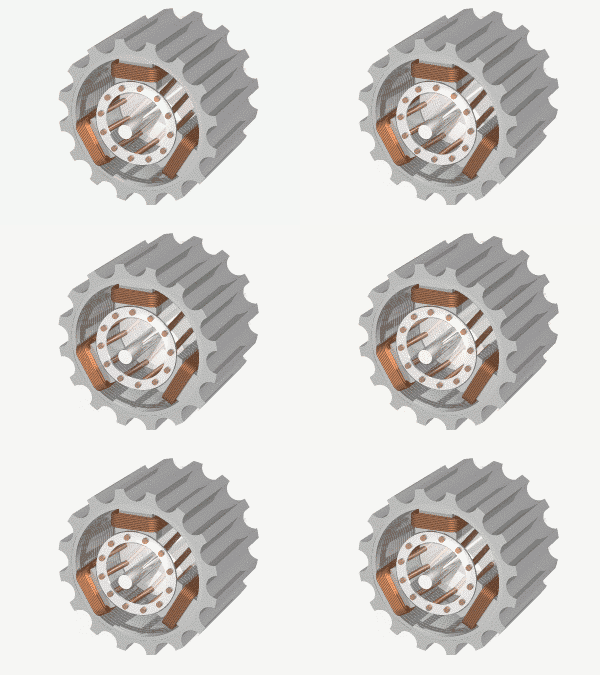
Figure 3. A squirrel cage is driven by a changing magnetic field created by the coils using alternating current. Image used courtesy of Ikaxer on Wikimedia
Inductive Sensors
Inductive proximity sensors work in the same fashion. Each sensor has smaller coils near the detection side that create an electromagnetic field. When a conductive material enters this area, it creates resistance within the magnetic field. This resistance is picked up by an internal oscillator that will trigger an internal circuit once a certain threshold is reached, creating a signal for automated applications.

Figure 4. A sensor uses a static magnetic field created by a wire coil. Image used courtesy of Balluff
Electromagnetic induction is a fundamental principle that transforms electrical energy into physical motion, crucial in various technologies like motors, sensors, solenoids, generators, starters, and many more devices. It involves creating an electromotive force (EMF) by moving a magnetic field around a conductor.
This dynamic process is essential for devices like induction motors, where alternating current produces changing magnetic fields, generating rotational motion and allowing sensors to detect conductive materials by measuring disruptions in the magnetic field. It’s a very simple technology that will be used as long as electromechanical devices are used.