9E MKV AC voltage problem

Hi,
We found a 110-126 VAC voltage to ground on ALL <QD1>, <QD2>, <CD> and PTBA negative terminals.
This is not affecting ( so far ) GT performance, except L52B_SEL input coming into PTBA, and GND monitoring, which is alarming and changes its value very much and constantly in DIAGC.
Disconnecting external AC and DC sources and chargers don't change anything.
We suspect DCF ( DC voltage filter ) and MOVs on the CPF board, located under the MKV panel. Also we suspect a <PD> card.
Any thoughts and assumptions would be much appreciated.

Thanks,

Jolek
 
@Jolek,

You have a good plan. The Mark* V is getting older (as we all are!) and components (capacitors, primarily) do fail. I have seen several <CPF> failures over a couple of decades.

BUT, the most likely cause is NOT an AC or DC source connected directly to the Mark* V, but a problem with either induced voltages because of close proximity to high current AC mains leads (such as 440 VAC motor leads, etc.).

Since nearly all of the 125 VDC devices powered by the Mark* V are in some way connected to each other, with perhaps some fuses separating them--which does not provide any kind of electrical isolation except when the fuses blow--a problem on one leg of a circuit becomes a problem for all circuits. And generally if there is some kind of direct connection to an AC source there will usually be blown fuses or some smoke that escapes from inside a printed circuit card.

You didn't say when this problem started, such as after a maintenance outage or some maintenance work--for example, in the cubicle where the L52B_SEL contact is located.... It would seem something has changed, possibly high voltage AC cables were "mistakenly" run in a low-level cable tray or electrical trench or were relocated after some repair or modification or equipment change. The fact that the status of L52B_SEL changes state often and frequently means that the AC on one or both of the wires of that circuit is affecting the Mark* V's ability to reliably detect the contact state (open or closed). This can happen when there is a problem with signal wires (such as contact inputs) are too close to high current AC wires/cables.

When something like this happens it's best to try to think back to the time around when the problem started and see if the source of the problem can be traced to that. If I recall correctly the L52B_SEL input terminals are on the <P> core terminal board (PTBA??) and not on one of the <CD> or <QDn> terminal boards.

You should still check the <CPF> components. But, don't presume the source of the AC is one of the AC sources connected to the Mark* V. Another thing to check is if the panel uses AC-to-DC converter(s) (<DACA>(s)) they are also known to fail from time to time, especially if the AC input source is not clean or if the site is struck by lightning during electrical storms.

Please let us know what you discover and how you resolve the problem.
 
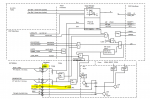
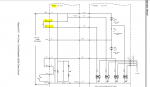
L52B_SEL does land on PTBA and is used in the synch scheme. Detailed in GEH-6195 section 7-10 "Synchronizing", and signal flow diagram D-57. I can't imagine having a chattering L52B_SEL isn't serious. As stated by WTF, the 125 VDC bus is connected to more than just the MK. Battery changers, the generator protection panel, dirty DC seal oil or lube oil commutators... all kinds of things on the 125 VDC bus can cause the ground fault. Its also highly site specific. Some sites have a low side generator circuit breaker, some don't. Some site have a single battery charger, some have dual chargers. So on and so forth.
ptba.PNG
autosync.PNG
signal flow.PNG
 
@White,

Thanks dor the snippets from the Mark V Application Manual, GEH-6195.

AND thanks for reminding us all that the same battery that powers the Mark* ALSO powers many other devices in addition to the Mark*. In addition to the Generator Protection/Control Panel the 125 VDC battery also supplies the Fire Protection Panel (and in some cases the fire detection system and discharge system). I don't know that this problem is being reported as a 125 VDC Battery Ground, and the fact that the L52B_SEL input status is toggling suggests some kind of induced voltage problem--at least in my experience. But reminding us all that the 125 VDC battery powers many other devices and systems which can come into contact with high AC currents/voltages is very important to remember.

The fact that the main offender being mentioned is L52B_SEL and that the status contact from this breaker selection status signal may (probably) comes from some location in either the Generator Protection Panel or some high-voltage switchgear cubicle location, and if some work was recently done in those areas it's highly possible that some wires were "disturbed" or relocated or added to the cable trays/trenches which maybe shouldn't have been.

I recall a Frame 9E installation that was having this same problem with high AC voltages to ground on the contact inputs and the problem was eventually traced to some wiring modification made in the Generator Protection Panel--to the Cooling Water Fan system!!! The unit was kind of a black start unit and for some reason the cooling water fan vibration switches for the fans that were part of the black start scheme were wired into the Generator Protection Panel and when routing new motor leads to the cooling water skid they were added to the wrong cable tray and caused induced AC voltages on the contact input circuits that were sometimes intermittently also reported as 125 VDC Battery Grounds (though not hard battery grounds), and that usually happened when the cooling water pumps were starting, but not every start (making the problem difficult to trace).

Anyway, hopefully @Jolek will let us know what the cause is determined to be.
 
In my experience, L52B_SEL is usually used to change synchronizing parameters for synchronizing to a grid or other power source which might have different PT voltages or synch parameters (such as a tie-line breaker or similar). Sometimes the signal comes from an auxiliary relay; sometimes it's from a high-voltage breaker or cell status switch. We presume there is a wire connected to the PTBA input terminal for 52B_SEL.

And if the second breaker is rarely, if ever used, it should be possible to disconnect the wire temporarily to see what happens to the AC voltage on the circuit.

This kind of problem is usually somewhat difficult to isolate, because the source of the (induced) AC voltage might be on the "signal" leg of a status contact and if the contact is closed then that problem can be "connected to" or "fed" to the "bus" or "common" side of the circuit--which feeds one side of EVERY contact input. Sometimes it's necessary to shut the machine down and start isolating different blocks of contact inputs and DTBA/DTBB and PTBA terminal boards (of Mark* V turbine control panels). This eventually means disconnecting individual wires from the terminal boards and leaving them disconnected until the root cause is identified. And then reconnecting the disconnected wires after the cause has been identified and resolved. So, taking good photographs of the wires on the terminal boards BEFORE disconnecting them is ALSO very important.

It could also be the PTBA terminal board, or the TCTG I/O card (for a gas turbine application).

Lastly, if it's been "a while" since conductive grease was put on the Mark* V ribbon cable pins/connectors hat could be a contributing factor, also.

Again, hopefully @Jolek will let us know what the cause is determined to be.
 
@WTF? , you were pretty much close in your assumptions.
After checking that both chargers, AC and DC power supplies are not the cause, and varistors and ACF and DCF on CPF board are OK, we decided to disconnect DTBA/DTBB inpits ( luckily, we modified them to marshalling terminal blocks many years ago, to ease GND troubleshooting ) and found the problem ( a combination of two, actually ).
Some 15 years ago, a new MEE Fog system was installed and one of the ground wires was mistakenly connected to nearby (107) terminal. It never caused a problem, until recently a PLC of the MEE system was changed and AC voltage wire, also by mistake, was connected to wire going to MK-V.
So, thanks A LOT WTF? and White for your participation and contribution to our knowledge base.(y)
 
Top