Facebook
 Google
 GitHub
 Linkedin
Grease to Green: Siemens’ Relays Get a Sustainable Spin
Envalior’s used cooking oil-based plastic gives Siemens’ 3RQ4 relays a greener edge, reducing carbon footprint and supporting circular design.
Siemens and Envalior have joined forces to advance sustainable electronics manufacturing with the Siemens SIRIUS 3RQ4 coupling relay, featuring Envalior’s cooking oil-based Akulon K225-KS B-MB bioplastic. By replacing up to 80% of fossil-based materials, the new relay promotes recyclability, lower emissions, and circular design principles. The halogen-free, compact relay meets Siemens EcoTech and TÜV Rheinland standards, marking another step toward environmentally responsible industrial device production.
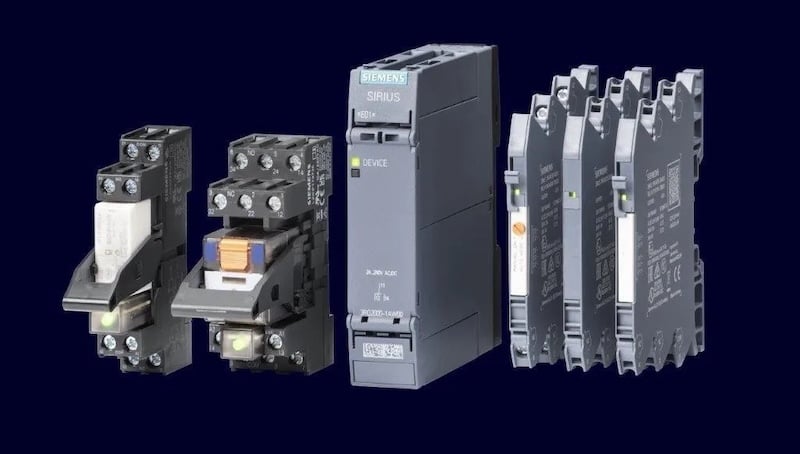
Customers can replace defective relays without replacing the entire product, improving repairability and sustainability. Image used courtesy of Siemens
Moving Towards a Circular Economy
The main raw material of Envalior’s Akulon K225-KS B-MB plastic is derived from UCO, a waste by-product of the food industry, with sources including restaurants and cafes, hospitality venues, and more.
Bioplastics are an important solution contributing to reducing carbon dioxide generation (which essentially lowers the carbon footprint of bioplastics-based products), as biologically/plant-derived cooking oils involve a life-cycle by which carbon dioxide is captured during photosynthesis. This energy-generating process feeds into plant biomass. Otherwise, conventional plastics involve a life-cycle within which synthesis occurs in laboratory and at a larger scale, factory environments, generating energy, waste heat, and carbon dioxide emissions that are in excess, not offset by the previously mentioned bio-based carbon-capture processes.
So what exactly are bioplastics, and why are they important for promoting a circular economy? Video used courtesy of USDA ARS’s AgLab
Another sustainable feature of UCO for electronic parts and components (which, in an era of global climate change and a global government drive for lowering emissions and seeking more green, sustainable methods of product creation and business processes) is recyclability. Used cooking oil is taken and instead of being used singly and thrown away, is recycled to generate plastics like Envalior’s Akulon K225-KS B-MB. This circular process of recycling feeds directly into the concept of a circular economy, wherein societal processes for managing the life cycle of products and systems follow systems we see in nature.
The Envalior’s Akulon K225-KS B-MB is a bio-based version of Envalior’s original Akulon K225-KS. As with the original Akulon K225-KS, the Akulon K225-KS B-MB plastic is halogen-free and flame-retardant with high heat and chemical resistance.
The SIRIUS 3RQ4 Coupling Relay
Siemens has built its SIRIUS 3RQ4 coupling relays with scaling its sustainability impact in mind, with the technology meeting the stringent requirements of its Siemens EcoTech label. Siemens products that bear this certified label undergo a standardized assessment, externally validated by global inspection company, TÜV Rheinland, using ISO (International Organization for Standardization) standards 14020 and 14021.
The SIRIUS 3RQ4 coupling relay is also ATEX-certified and approved for safe use in hazardous, explosive environments. B10d values offer an added measure for safety, representing the number of cycles at which 10% of a given device’s contacts are predicted to fail, given contact wear and degradation. Customers might also choose gold-plated contacts for low-current switching or printed circuit boards (which are halogen-free) with a protective coating to apply to outdoor applications such as railroads.
Halogen-free materials help improve waste plastic recycling, reducing the steps required for careful handling and removal of toxic chemicals and minimizing their release into the environment, which is known to negatively impact living organisms. For manufacturers and other industrial businesses, investing in bio-based, halogen-free materials is a great way to support sustainability goals and targets in line with government policies.
The SIRIUS 3RQ4 coupling relay features a slim, compact form factor for economizing on control cabinet space and a UL94 V-0 rating with a 0.4 mm thickness. The relay’s housing uses 70% of Envalior’s Akulon K225-KS B-MB cooking oil-based plastic and replaces 80% of the fossil fuel-derived materials that would have been used to create the same product.
Siemens Xcelerator offers its SIGREEN tool to help provide data and insights concerning supply chain emissions and product carbon footprints (PCF). Video used courtesy of Siemens Knowledge Hub
Overall, Siemens' latest relay device is an attractive purchase with embedded circular economy-enhancing recyclable materials, a space-saving form factor, reduced carbon footprint, and a halogen-free design to enhance worker safety, reduce toxic chemical waste, and improve recycling of plastic parts. Other aspects of the SIRIUS 3RQ4 coupling relay’s sustainability-focused features include reduced power loss for semiconductor variants, 50% savings in packaging, a design focused on ease-of-disassembly (for circularity), and high current semiconductor switching with no contact wear for greater longevity.