Facebook
 Google
 GitHub
 Linkedin
Motion Meets Safety With New CIP Plug-In Module for ABB Drives
ABB has expanded and upgraded the safety capability of flagship VFDs with an Ethernet/IP CIP plug-in module capable of sending safe torque off (STO) and safe stop signals without additional wiring.
Three of the most popular series of motor drives from ABB will now have the option of adding a CIP safety communication module, greatly reducing integration time by eliminating the need to manually wire individual safety signals.
VFD Safety
The job of variable frequency drives (VFDs) is to supply 3-phase voltage to AC inductive motors. They use special inverters to adjust the frequency of the electrical supply, which in turn controls the speed of the motor. These motors could be turning flywheels, mixers, or even cutting machines, so safely controlling these devices is imperative.
ABB offers a wide array of motor drives for low-voltage systems, which include three flagship models: the ACS380 which is commonly used in automation machinery, the ACS580 for general-purpose applications, and the ACS880 designed for industrial machine enclosures.
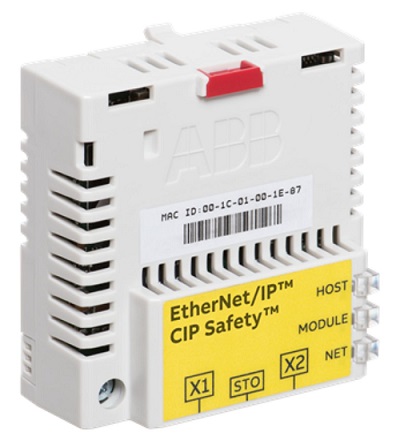
The new FSCS-21 CIP Safety module. Image used courtesy of ABB
CIP Safety Module FSCS-21
Common Industrial Protocol (CIP) is a communication channel used by industrial devices to pass data back and forth to a safety control system. The protocol is commonly used on top of Ethernet/IP and will interface with any supporting PLC. The new FSCS-21 from ABB is a plug-in module that connects to several specific VFD models offered by ABB that are commonly used in machinery, industrial settings, and general purposes.
Once connected to the drive, the module is capable of interfacing with a safety-rated PLC, such as the GuardLogix line of PLCs from Rockwell Automation, or with gateways that convert safety protocols like PROFIsafe into CIP Safety for various manufacturers. There are two built-in safety functions of the FSCS-21: Safe Torque OFF (STO) and Safe Stop 1.
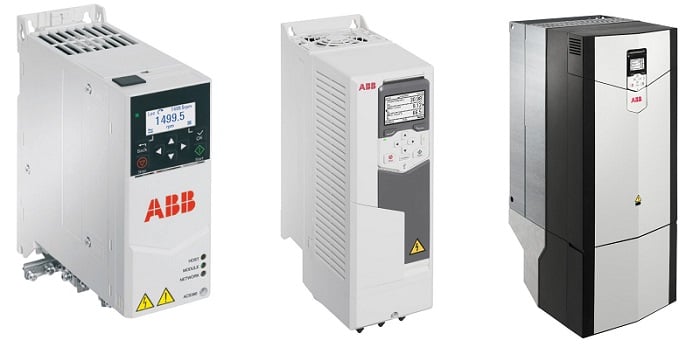
The three compatible drives for the new CIP Safety module: the ACS 380, ACS580, and ACS880 from L-R. Image courtesy of ABB
Safe Torque Off (STO) is a function found with most motion drives. Typically this signal comes from a safety relay, contactor, or safety PLC and is hard-wired to the drive. When the signal goes low (0 VDC), the drive disconnects all power to the motor so that there is zero torque at the motor shaft. With a CIP system, the logic within the control system monitors specific conditions, and the safe torque off signal is sent over the communication interface.
Safe Stop 1 is a controlled stop of the motor through the drive. When a safe stop 1 is initiated, the drive will decelerate the motor rapidly until a standstill is achieved. At this time, the safe torque off signal will be activated, resulting in a zero torque situation at the motor drive shaft. Similar to the STO signal, the safe stop signal can be sent over the ethernet protocol instead of wiring safety outputs to the drive with the FSCS-21 module.
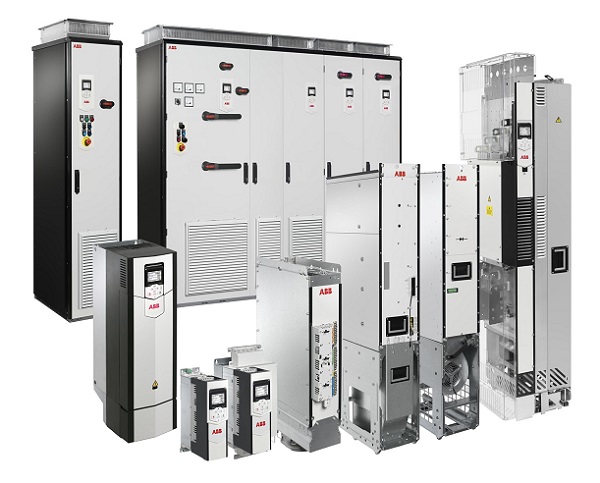
A collection of VFDs displaying various frame and enclose styles. Image used courtesy of ABB
Safety Functions in a Control System
These safety functions allow designers to create safe machinery and the FSCS-21 makes the lives of the programmers easier because they won’t have to troubleshoot safety I/O wiring. If your drive doesn’t have a CIP module, then at a bare minimum, the STO signals will need to be wired from your safety system. This commonly requires a safety PLC, safety contactors, and safety I/O cards. All of these components are very expensive as they bear the proper ratings for safety classification. With a CIP module like the FSCS-21, you only need a safety PLC to integrate your motion drive with your safety system.
Interested in more info about motors and motor controls?
Have a look at some of the educational links below.
Articles:
- Comparing Single-Phase and Three-Phase Motors
- 3-phase Motor Types: Synchronous and Induction Motors
- Understanding Delta Wound Motors for Industrial Applications
- Brushed vs. Brushless DC Motors
- Field-oriented Control (Vector Control) for Brushless DC Motors
- Teardown: What’s Inside a 3-Phase Induction Motor?
Textbook:
Related Content