 Facebook
 Google
 GitHub
 Linkedin
NVIDIA GTC Showcases Physical AI Advances From Comau, KUKA and KION
At NVIDIA GTC, Comau, KUKA, and KION showcased physical AI advances spanning robot simulation, virtual factory design, AI-enabled control, and warehouse automation.
At NVIDIA’s annual GPU Technology Conference 2026, industry leaders in industrial automation robotics solutions showcase their latest technological partnerships and innovations with a central focus on the integration and scaling of Physical Artificial Intelligence solutions. Join us for an overview of the latest advancements from leading experts in robotics and automation, including Comau, KION, and KUKA.
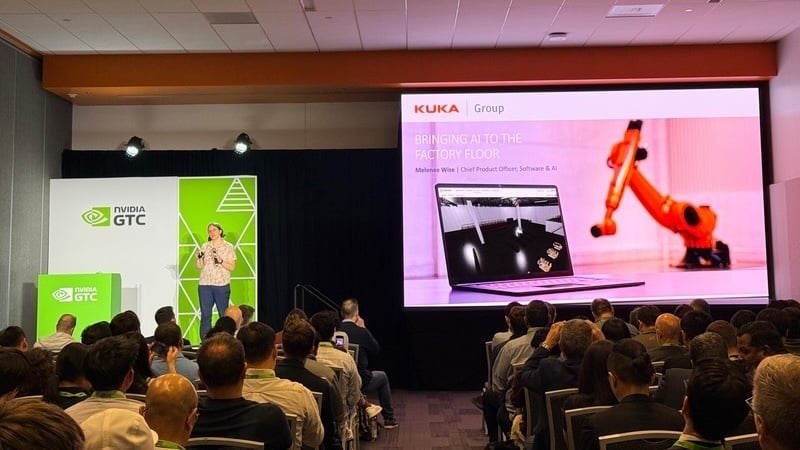
KUKA brings AI to the physical factory floor, introducing KUKA AMP at NVIDIA GTC. Image used courtesy of KUKA
Comau
Comau and NVIDIA are working together to integrate their technologies and advance innovations in intelligent, AI-backed robotics and automation solutions for global customers. Comau is combining its industrial robot controller technology with NVIDIA Jetson Edge Compute. NVIDIA Jetson is a powerful, AI-infused computing platform with key architectures and frameworks that enable real-time machine vision, navigation, adaptive motion planning, and other capabilities that advance machine intelligence in automated industrial systems.
Comau has also merged its robotic portfolio with NVIDIA Isaac Sim (built on NVIDIA Omniverse), providing advanced simulations of robots and robotic workflows that let engineers and developers test and optimize before deploying on the factory floor. Customers can also generate visual and sensor training data to train AI models for machine perception, object handling, navigation, and more, speeding time to deployment.
Comau is making its industrial robot models publicly available in NVIDIA's Hugging Face SimReady Library to speed up intelligent automation and drastically reduce development cycles for engineers worldwide. At the same time, Comau is using Isaac Lab and NVIDIA Isaac Sim to develop and refine AI-powered control strategies for its MI.RA vision systems and logistics machinery. The idea is to use a photorealistic virtual environment to develop, optimize, and validate technologies before deployment.
KUKA
Visual Components showcased FactoryLens at NVIDIA GTC. FactoryLens is a photorealistic visualization tool that lets manufacturers view existing factory layouts and simulation workflows in real time, rather than in separate visualization software. Universal Scene Description unifies multiple data layers about machine setup on the physical factory floor and how it connects to other machinery in an automated system. AI developers can create highly realistic, intricate virtual environments with OpenUSD, a powerful software layer, to train intelligent AI agents and physical robots. The "nondestructive" nature of the software means it is the physical blueprint of the digital factory. Engineers can test and evaluate millions of scenarios and modifications to find optimal machine paths and automation setups before real-world deployment.
KUKA also revealed KUKA AMP at NVIDIA GTC, offering the world a connective bridge between AI agents and physical machinery. The sophisticated automation management platform has three key elements that translate automation goals into physical reality on the shop floor: semantics, action, and data. This platform, coupled with FactoryLens and AI-driven applications such as iiQKA.AI Vision, is intended to help manufacturers evolve their operations by optimizing the flexibility, adaptivity, and connectivity of their systems.
At NVIDIA GTC, industrial automation experts convened, conversed, and shared innovations driving the next automation revolution. Video used courtesy of NVIDIA
KION
KION brought its Physical AI integration success story to NVIDIA GTC, showing that continued collaboration with Accenture and NVIDIA is speeding development and deployment of Physical AI applications for customers worldwide.
KION built digital twins, virtual replicas of warehouse operations, to test and optimize software and autonomous robot fleets before deploying them in situ. AI-driven simulation helped reduce deployment time by over 60%, from a few weeks to a few days. KION achieved successful deployment of an autonomous fleet of vehicles at a GXO Logistics warehouse in Épinoy, France.
Physical AI's ability to develop and enhance automated industrial operations is a key growth driver for customers in manufacturing and intralogistics worldwide. Pioneering companies such as NVIDIA, KUKA, KION, and Comau are driving the transition from inflexible, rigid automated manufacturing operations towards flexible, intent-driven autonomous systems.