Facebook
 Google
 GitHub
 Linkedin
SMC Expands CQE Compact Cylinder Series with Higher Output Design
New CQE compact cylinders from SMC deliver up to 1.5 times the theoretical output of CQ2 models, with new sizes, strokes, and configuration options.
SMC has expanded its CQE Series High Power Type compact cylinders with new bore sizes, longer stroke options, and intermediate strokes in 1 mm increments. The series uses a polygonal piston to provide up to 1.5 times the theoretical output of similarly sized CQ2 cylinders, with each CQE size offering the theoretical piston area of the next larger bore. The design can give machine builders more force without increasing cylinder dimensions, while also supporting lower-pressure operation and flexible installation in compact pneumatic equipment.
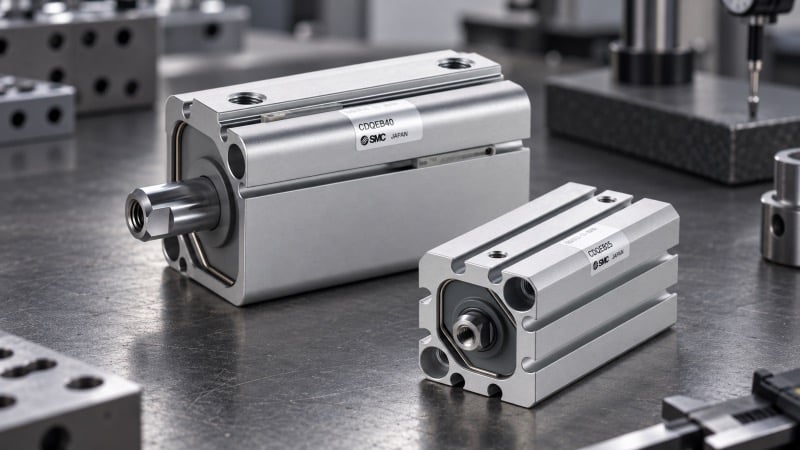
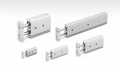
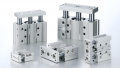
SMC’s CQE Series compact cylinders deliver higher power while maintaining the same external dimensions as the CQ2 Series. Image used courtesy of SMC
More Output Without a Larger Cylinder
The CQE Series is available in sizes 20, 25, 32, and 40, with sizes 25 and 40 being newly added. SMC also added 75 mm and 100 mm cylinder strokes for sizes 32 and 40, expanding the range for applications that need further travel. The polygonal piston is the main mechanical difference behind the higher output design. In the catalog, SMC lists each CQE size as having a piston area equivalent to the next-largest round-bore cylinder. For example. size 20 is equivalent to ø25, size 25 is equivalent to ø32, size 32 is equivalent to ø40 and size 40 is equivalent to ø50. That's what gives the cylinder higher theoretical force while maintaining the same compact body dimensions.
This can help machine builders in clamping, press fitting, and other applications where force matters but installation space is limited. A compact cylinder that delivers more output may help avoid changes to brackets, guards, or machine frames originally designed around smaller actuator dimensions. In simplest terms, your fabrication team will thank you for the consideration.
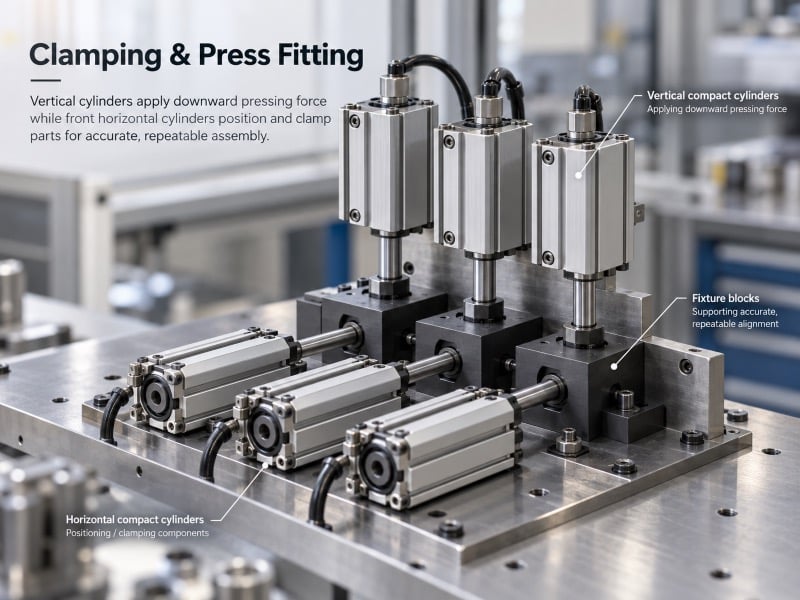
Visual of compact cylinders being used in a clamp and press fit fixture, where vertical cylinders apply pressing force and horizontal cylinders help position for repeatable assembly. Image used courtesy of SMC
Lower Pressure Operation
The higher output design also supports lower-pressure air lines. SMC gives an example where the same theoretical output is available even when cylinder supply pressure is reduced. In the example, a CQE size 32 can reach a theoretical thrust of 402 N at 0.33 MPa, compared with an existing CQ2 ø32 cylinder requiring 0.5 MPa for a similar output.
That represents a 0.17 MPa decrease in supply pressure. The practical advantages extend beyond cylinder performance. Lower supply pressure can help reduce compressed air demand across the machine or line, depending on the system layout. In facilities where compressed air is a major utility cost, even small pressure reductions can add up over repeated actuation cycles. However, that doesn't mean every application can simply lower air pressure and get the same result. Pneumatic systems still have to account for load, speed, friction, orientation, safety margins, and of course, response time. But the CQE Series gives designers more room to evaluate lower-pressure operation without immediately sacrificing actuator output.
Intermediate Stroke Flexibility
SMC also added intermediate-stroke compatibility, one of the most useful configuration changes in the expanded series. Instead of forcing the designer to select only standard stroke lengths, the CQE Series supports intermediate strokes in 1 mm increments. The series offers two ways to handle intermediate strokes. The first is a spacer-installed type, where a spacer is installed inside a standard stroke body. The second is an exclusive body type, identified by the -XB10 suffix. The exclusive body type is made specifically for the selected stroke and can make the overall cylinder length shorter than the spacer-installed version.
Again, that distinction matters when machine space is tight. A spacer-installed cylinder can be convenient because it uses a standard stroke body, but it may add unnecessary length. The -XB10 exclusive body option gives designers a cleaner fit when the installation envelope is more restricted. SMC also added a rod end shape change option to give engineers another way to adapt the cylinder to specific mechanical interfaces.
Core Cylinder Specifications
The CQE Series is a double-acting, single-rod compact cylinder designed for air use. The standard mounting configuration is through-hole/both ends tapped common, giving designers installation flexibility.
Key operating specifications include a maximum operating pressure of 0.7 MPa, minimum operating pressure of 0.05 MPa, and a piston speed range of 50 to 500 mm/s. The series uses a rubber bumper cushion and is specified for -10 to 60 °C ambient and fluid temperatures when used with an auto switch. Lubrication is not required. You can mount compact auto switches, and the catalog lists compatible solid-state auto switch options from the D-M9 series. SMC also notes that, because of the polygonal piston, the piston rod does not rotate during normal operation. This can matter in applications where rod orientation affects tooling, contact position, or mounting consistency.
Designed for Compact Pneumatic Equipment
The series is especially relevant for compact pneumatic system tasks where output force and installation size compete. SMC gives designers more ways to tune cylinder selection around space, pressure, and force requirements with the addition of the new 25 and 40 sizes, longer strokes, intermediate stroke options, and overall higher theoretical output.
For builders trying to reduce air pressure, avoid larger actuators, or fit cylinders into crowded machinery, the expanded CQE Series gives SMC’s compact cylinder lineup a stronger high-power option.