Facebook
 Google
 GitHub
 Linkedin
UBTech Walker S2 Swaps Batteries Autonomously
Walker S2 swaps its battery without human help, keeping humanoid robots charged, safe, and productive on the factory floor.
UBTech’s Walker S2 humanoid robot tackles a common challenge in battery-powered devices: downtime and safety concerns when power runs low. Standing 5’ 3” and weighing 95 lbs, the Walker S2 can detect low battery levels and autonomously swap its own power pack in under three minutes. This self-service capability keeps operations moving without human intervention, reduces the risk of stalled robots in busy environments, and ensures continuous productivity in industrial and service settings.
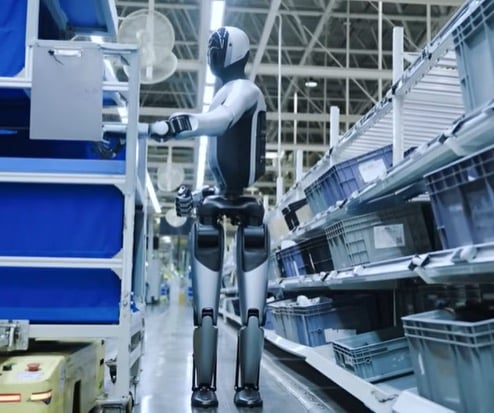
The Walker S2 picking items from bins. Image used courtesy of UBTech
Battery Anxiety
With all battery-powered devices, there is always a concern about battery life. However, battery life itself is only half of the problem. For many devices, the deeper concern is not, “how long will the battery last?” but “what happens when the battery dies?”
Perhaps the consequences of a dead battery are a nuisance, such as working on a DIY project and finding that the cordless drill’s battery is dead. A dead battery could lead to a safety concern for other items, such as a 95 lb battery-powered humanoid robot carrying a load. Will the robot remain upright when the battery dies? Will it drop its load? What will happen near the end of the battery’s life?
Rest and Recharge for the Walker S2
UBTech has developed an answer to these questions. Their new Walker S2 humanoid robot can detect when its battery is getting low. Rather than waiting for a human to change the battery, it changes its own battery. This action is fully autonomous. It walks to a charging station and can plug in, or remove its battery and replace it with one on the charger–a trick every DIY’er has used to ensure power is always available.
The Walker S2 can perform the battery swap in under three minutes. It requires virtually no human interaction to perform this swap, meaning downtime is reduced significantly. It uses its human-like arms to remove the dying battery and place it on the charger. Then, it selects and places a charged battery.
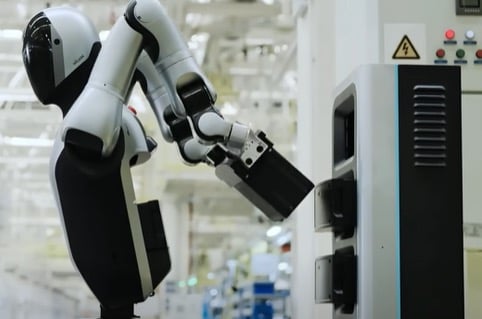
The Walker S2 has removed a dying battery and is placing it in the charger behind its head. Those 20 degrees of freedom give it more options for range of motion than a human. Image used courtesy of IoT World Today
Applications and Advantages
The ability to change its own battery makes UBTech’s robots safer in human spaces. Rather than behaving unpredictably and potentially collapsing or dropping a load near the end of their battery lives, they can self-monitor and take action. Replacing the battery autonomously means not relying on someone to notice a slower-moving humanoid robot, retrieve a battery pack, or move a stalled robot from the factory floor.
It is also possible to reduce downtime by having more batteries than humanoid robots. They can work until the battery is low, and then take a quick battery-change break. Then, they are back out on the floor, working again. No waiting around for humans, no need to plug in and wait for the battery to charge.