Gas Turbine High Spread

L

Thread Starter

Louis

We have a Frame 6 machine with MkV control system. We are experiencing high GT spread and we are unable to point out the root cause of the problem.

Following were observed:

1) High temperture is mostly in the thermocouple 9 & 13 even after replacing / swapping the fuel nozzles.

2) Erratic reading was observed in thermocouple 9 wherein the reading suddenly reduces drastically and immediately after that it comes back to normal.

3) We have presently disconnected the thermocouple 9 because of erratic readings.

4) Following is the thermocouple readings before disconnecting thermocouple 9:
( From 1 to 18 thermocouple)
521
522
524
524
526
529
533
538
411
553
562
561
559
558
555
548
537
526
TTXM 539Deg C
CTD 333 Deg C

5) Readings after disconnecting the thermocouple 9
( From 1 to 18 thermocouple)
547
542
544
559
547
568
593
602
-83
613
591
598
592
570
564
564
562
548

TTXM 572Deg C
CTD 353 Deg C
 
You are experiencing problems with exhaust T/C feedback which is causing the exhaust temperature spread (the differential between exhaust temperature T/C readings) to be high, which is an indication of combustion problems (cracked liner; fuel nozzle problems; failed side seals; failed hula skirt seal; transition piece problem; etc.).

You didn't say what fuel the machine was burning or what loads the two sets of readings you provided were taken at.

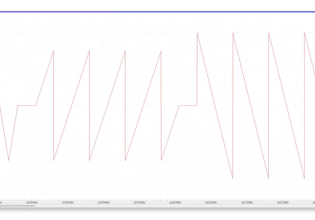
In looking at the data, I don't see that T/Cs 9 or 13 are the highest values; in fact, it appears from both sets of data that T/C 9 is the lowest value.

A true exhaust temperature spread, as defined by the way the Combustion Monitor algorithm and sequencing works, is that the highest/lowest exhaust T/Cs must be adjacent and the second highest/lowest must also be adjacent. This indicates a real problem, not just a single exhaust T/C reading that is extremely high or extremely low, which is usually ignored by the Exhaust Monitor algorithm just because they are generally anomalies and not true indications of combustion problems.

If you are having erratic feedback from a single T/C then it usually means that T/C, or it's circuit, is experiencing problems. One of the failure modes of T/Cs can be that they have intermittent and erratic outputs. So, replace the exhaust T/C. Make sure the T/C termination all along the circuit's length (from the first junction box near the Load Compartment/Exhaust) all the way to the terminations on the TBQA in the Mark V) are tight (not overly tight, but firmly tight).

When you want to "remove" a failed or failing exhaust T/C from the system, the typical method is not to disconnect it. As you can see, the Mark V interprets open circuit T/Cs as an extremely low reading, negative, in fact. The usual action is to disconnect the input and jumper one of the adjacent T/C inputs to the disconnected T/C's input terminals.

For example, if exhaust T/C 9 is failed or failing, disconnect it from the TBQA terminals and use jumpers (short lengths of plain copper wire will suffice, but pieces of T/C extension wire would be better) to jumper exhaust T/C 8 or -10 to exhaust T/C 9's input terminals.

<b>NOTE: Exhaust T/C's are **NOT** terminated in sequential order on the TBQA!!!</b>

<b>NOTE: Jumpering exhaust T/C's while the unit is running can be very tricky and can result in a turbine trip!!!</b>

Exhaust temperature spreads are not always related to fuel nozzle troubles. It could be a problem with a combustion liner that has developed a crack or a hole, or problem with a hula skirt seal or a cracked transition piece, in which case moving fuel nozzles will not cause the cold spot to move with the fuel nozzle.

I'm betting the problem is with the exhaust T/C itself or with the wiring or terminations in the circuit.

I neglected to ask when this problem started; after a maintenance outage? Just suddenly?

How long has the unit been running without excessive exhaust temperature spreads?

When was exhaust T/C 9 last replaced?
 
The thermocouple readings you provided looks like they weren't taken at same loading of the unit. It's better you submit readings at same load so that anybody may not be mislead to make a logical comment. So provide more detail pls.

M M Ahsan.
 
Thanks for your immediate response.

1. The fuel which we were using was Naphtha

2. Following are the history

a) We replaced the complete exhaust system including the guide shield radiation tubes.

b) We replace the hula seals, side seal retainers,transition pieces every year. (Problem of exhaust high spread is persisting for last 3-4 years)

c) Hot zone is predominantly located at TC no. 9 to 13 at GT load above 25MW to base load (Hot zone doesn't change with the change in load)

d)No major variations observed in the fuel nozzle pressures.
 
sir may i know about
* actual spread
* allowable spread
how can we calculate from TC reading?

plz give a reply sir
 
james,

You haven't given us enough information about the combustion turbine(s) and control system(s) at your site.

This topic has been covered many times on control.com as regards, GE-design heavy duty gas turbines and Speedtronic turbine control systems. You will find a 'Search' function at the far right side of the Meny Bar at the top of every control.com page.

As with any electronic search function, do not be discouraged with your first search. Try multiple terms and words, and expand your search based on information you find in your searches.

I suspect you will be most interested in learning what to do about high exhaust temperature spreads and how to troubleshoot high exhaust temperature spreads. This has also been covered in multiple threads on control.com.

As a precursor to your exploration, here are some key things to remember about combustion turbine exhaust temperature spreads:

1) They are almost never "caused" by the control system. The exception to this is failed, failing, or intermittent exhaust T/Cs or improperly inserted thermocouples (in their radiation shield enclosures), and this is relatively easy to spot and rectify but may require a shutdown and cooling of the turbine exhaust for a full and proper inspection.

2) They are almost always the result of mechanical problems--plugged fuel nozzle orifices; problems with mechancial reassembly after maintenance outages; cracked combustion liners or transition pieces; etc.

3) For Speedtronic turbine control systems used on GE-design heavy duty gas turbines the allowable exhaust temperature spread is calculated using the axial compressor discharge temperature thermocouples, so these must be working properly for the allowable spread to be calculated properly, and are also susceptible to failure and improper insertion into their thermowells.

Best of luck. If you require more information about a specific problem you are experiencing please provide more information (much more information) about when the problem started, what you've done to try to troubleshoot the problem, what the results of the troubleshooting were, and what fuel(s) you are experiencing the problem(s) on.
 
Top