 Facebook
 Google
 GitHub
 Linkedin
A Superior Intelleqt: ABB Announces “World’s First” Smart Motor
The ABB Intelleqt smart motor adds built-in sensing and edge analytics to IEC low-voltage motors, helping maintenance teams identify potential failures earlier.
ABB has introduced Intelleqt, an IEC low-voltage motor system that integrates condition monitoring sensors and data analytics directly into the motor. Designed to combine IE5 efficiency with predictive maintenance capabilities, Intelleqt monitors vibration, winding temperature, and magnetic flux to identify potential mechanical and electrical problems. An onboard edge computer processes sensor data, while Bluetooth and Wi-Fi connectivity provide access to operating information and trends. Customers can also connect the motor to plant systems such as SCADA and ERP platforms or use ABB Ability cloud services for more extensive analytics. The system is intended to help maintenance teams identify developing issues and reduce unplanned downtime without relying on separately installed monitoring hardware.
Intelleqt Motor Specification
Beneath the hood lies an IEC 3-phase motor that operates in a typical industry fashion. The motor drive control is provided via direct-on-line (DOL) or VFD voltage supply. The motor series includes models designed for 230-690 volt inputs at 50/60 Hz. The power outputs range from 11 kW (~15 hp) to 1,300 kW (~1750 hp), with frame sizes from 160 to 500 mm.
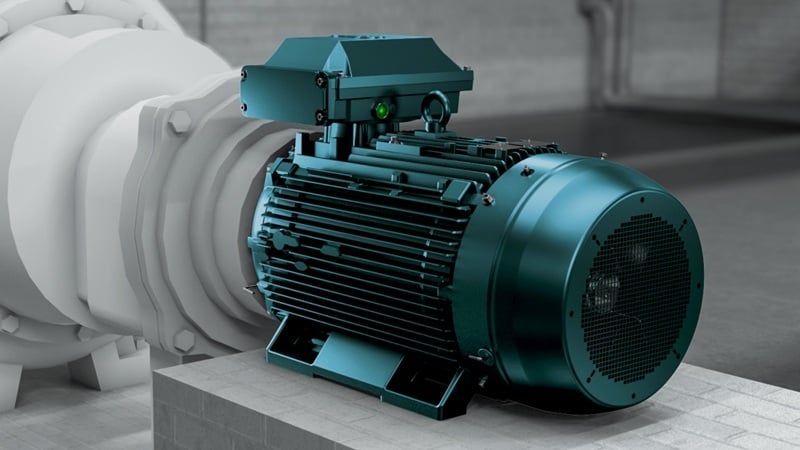
The new Intelleqt motor. Image used courtesy of ABB
Even in the electromechanical sense, the motor family represents industry-leading performance expected from ABB’s Motors and Drives division.
Smart Integrated Features
The highlight of the announcement isn’t really the motor itself; it’s the insights its performance provides. When a company uses the word smart, we should ask, “What makes this motor so intelligent?”
Sensors
First, the data needs to be collected. The Intelleqt series gathers three different critical data points. A vibration sensor detects mechanical fixturing and bearing failures, both inside and outside the motor. A temperature sensor is placed inside the coils and provides far more accurate detection of overcurrent anomalies than a sensor attached to the outside casing. Finally, a magnetic flux sensor detects changes in the interaction between the stator and rotor, enabling early detection of even very minor performance changes.
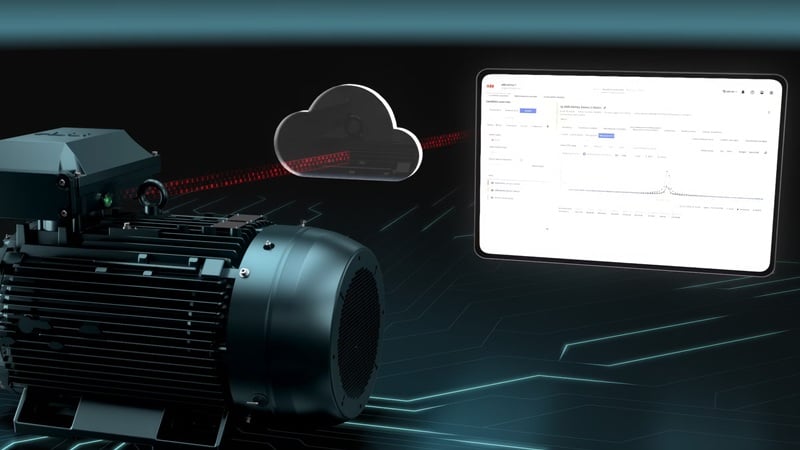
ABB Intelleqt provides analytics and exceptional motor performance. Image used courtesy of ABB
Processing
After the data is collected, it can be processed entirely onboard the motor. A built-in edge computer provides front-line analytics that detect the most immediate potential failures.
This computer is not the same as a motor drive, and it's important to understand the distinction. For integrated drive units, a constant voltage supply is provided to the drive, and the motor leads then receive a modulated voltage. In ABB’s Intelleqt system, analytics must still take place regardless of the voltage supplied to the motor leads. The sensors and computer are powered from the motor's magnetic field.
One point not provided by the datasheet is the duration of power to the sensing system while the motor is not running, but the datasheet states that no batteries are required for continual data connection.
The Intelleqt motor provides three tiers of data processing. The primary tier includes basic on-premises edge computation along with Bluetooth and WiFi connection. The next level connects the system to the customer’s SCADA and ERP systems and integrates seamlessly with other existing condition monitoring systems. Finally, ABB can handle all analytics, alerting, and insights through a connection to the ABB Ability Digital Powertrain cloud system.
Alerting
Insights need action, or they are not very useful. The most immediate performance indicator is an LED built right into the motor. Green, yellow, and red indicate a logical progression from normal operation to increasingly critical failures.
The LED provides immediate action recommendations, but the Bluetooth and WiFi connections provide longer-term trends and deeper insights. At the highest level, the cloud connections can provide all sorts of metrics from third-party SCADA and HMI software packages.
Smarter Motors for Smarter Engineers
I don’t mean to imply that engineers aren't smart if they don’t use the most advanced analytics. However, every engineer is certainly trying to find the best way to increase efficiency and decrease failures; it’s the main goal of every facility. By adopting best practices and new technology, like the ABB Intelleqt motor system, companies can set a new standard for performance in the industry.