Facebook
 Google
 GitHub
 Linkedin
Humanoid Robotics Gains Momentum: Key Players and Innovations in 2024
Explore milestones in the humanoid robotics industry, including FigureAI's first commercial deployment and AgiBot's launch of an open-source learning dataset for humanoids.
Humanoid robotics has rapidly showcased innovative transformation, moving from experimental concepts to concrete solutions. In December 2024 alone, the industry witnessed major players launching humanoid solutions to tackle global commercial and industrial challenges. Let's explore some key humanoid developments that mark a new era of embodied intelligence.
Figure AI’s general-purpose humanoid robot being tested in a BMW facility. Video used courtesy of Figure AI
Figure AI’s Commercial Milestone
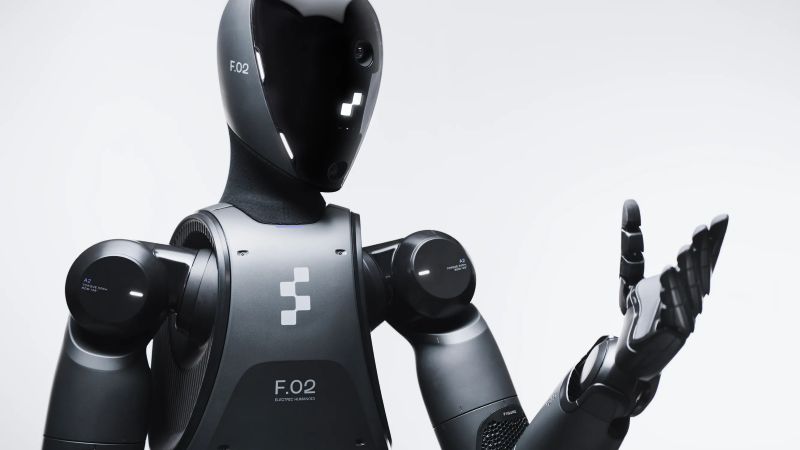
In a notable milestone, Figure AI has taken pride in delivering its Figure 02 humanoid robot to a paying commercial client. In December, the founder and CEO of Figure AI, Brett Adcock, announced the company’s first commercial deployment of the humanoid robot on LinkedIn, officially crowning Figure AI as a revenue-generating company. Figure AI was founded in Sunnyvale, California, and since its origin in 2022, has received a series of investments to develop a humanoid robot for commercial and industrial use.
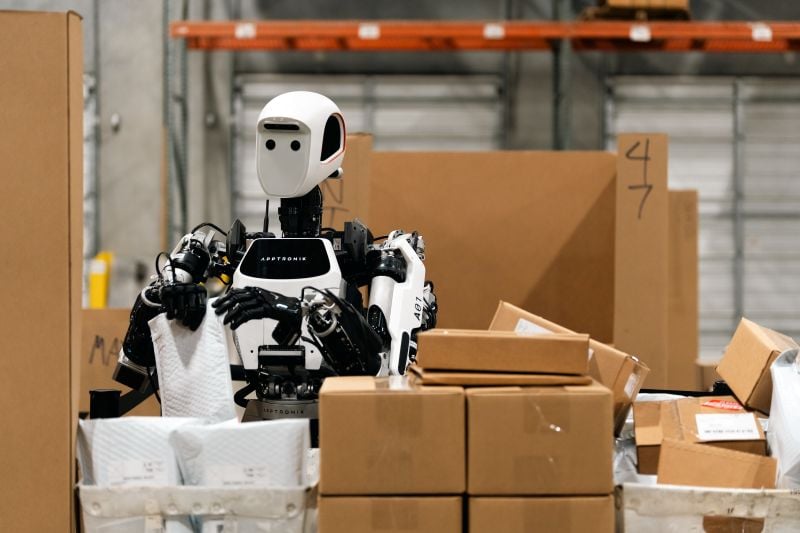
Apptronik’s Apollo humanoid robot is designed to perform challenging tasks alongside human workers. Image used courtesy of Apptronik
Apptronik and Google DeepMind
Apptronik, another humanoid robot-focused company, has partnered with Google DeepMind to integrate AI with advanced robotics. Apptronik was founded in 2016 at the Human Centered Robotics lab at the University of Texas. Notably, the company has collaborated with NASA on projects like the Valkyrie Robot, a humanoid robot developed for space exploration. Apptronik's latest innovation, Apollo, is a 172 cm tall, 72.5 kg humanoid robot built to perform physically demanding tasks while ensuring safe human-robot interaction in the industrial setting.
Apptronik’s latest partnership with Google DeepMind is focused on using AI, machine learning, and robotics knowledge to drive innovation. According to Jeff Cardenas, CEO and Co-founder of Apptronik, the partnership is focused on creating versatile, intelligent, and safe robots with Apptronik's robotics platform and Google DeepMind's AI expertise.
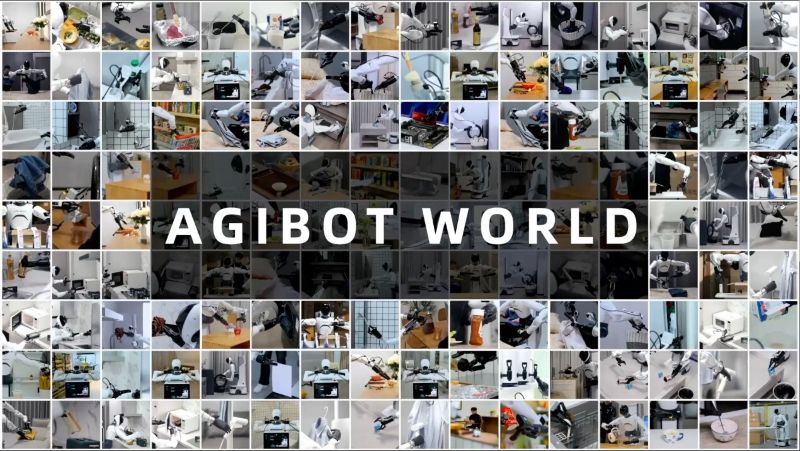
The AgiBot World platform will help to bridge the gap between research and real-world application of humanoids. Image used courtesy of Agibot
AgiBot’s AgiBot World
Another leading robotics startup, AgiBot, recently unveiled AgiBot World, the “largest humanoid manipulation dataset” ever created. The dataset comprises over 1 million trajectories collected from 100 humanoid robots, covering more than 100 diverse real-world scenarios. These scenarios are designed to simulate the complexities of real-world robotics applications, including fine-grained manipulation tasks, the use of tools, and the coordination of multiple robots. Offering more than just datasets, AgiBot World also includes standardized benchmarks, foundational models, and collaborative frameworks that aim to make high-quality data accessible to everyone.
AgiBot World leverages advanced multimodal hardware, such as durable 6DoF hands for precision manipulation, mobile dual-arm robots equipped with whole-body control for complex tasks, and array-based visual and tactile sensors for enhanced perception. These technologies aim to open up new possibilities for research in areas like multiagent collaboration, multimodal imitation learning, and adaptive manipulation in dynamic environments.
The PM01 is powered by a dual-chip technology consisting of an Intel N97 processor and an NVIDIA Jetson Orin that provide high-performance capabilities. Image used courtesy of EngineAI
EngineAI’s Open-Source Humanoid
China-based robotics company EngineAI has recently added the PM01 open-source humanoid robot to its offerings. The human-like bionic design is constructed from an aluminum alloy exoskeleton. It offers a single degree of freedom in its neck, six degrees in one leg, and five degrees in a single arm, enhancing the robot's mobility. The robot is equipped with an Intel RealSense D435i depth camera, which enables it to perceive its environment more effectively. The humanoid boasts a natural walking gait, thanks to simulations and reinforcement learning that allows continuous self-evaluation.
The PUDU D9 is designed to navigate difficult terrain, including slopes and stairs. Image used courtesy of Pudu Robotics
Pudu Robotics' Launch of PUDU D9
A leader in the service robotics industry, Pudu Robotics recently announced its latest innovation, the PUDU D9, a full-sized bipedal humanoid robot. The robot features a weight of 65 kg, a height of 170 cm, and a top walking speed of 2 m/s. One of the key features of the PUDU D9 is its dynamic mobility, which enables navigation in a wide range of environments. The PUDU D9 can handle flat surfaces, slopes, stairs, and other challenging terrains with ease. The new robot has a lightweight gait control algorithm and a high-accuracy visual semantic navigation system. It creates real-time 3D maps of its environment, ensuring precise self-positioning and autonomous route planning in complex environments.
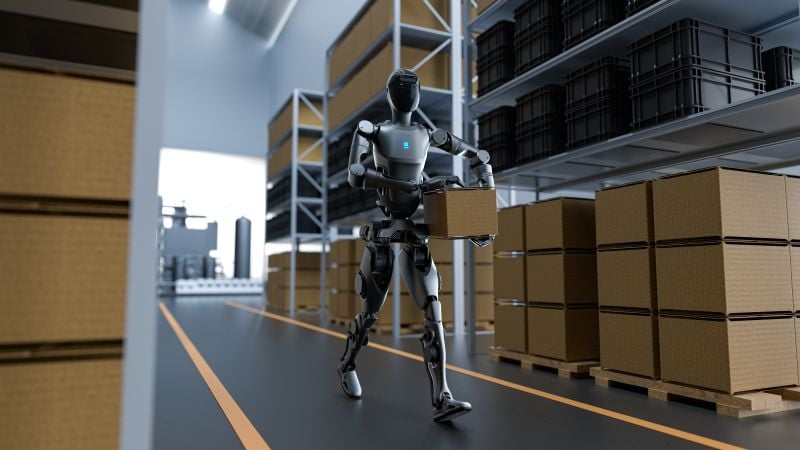
Humanoids will see greater use in commercial and industrial applications by the end of the decade. Image used courtesy of Figure AI
2024 Highlights and Challenges
The humanoid robotics industry has witnessed a steep growth trajectory in 2024, with a projection by ABI Research estimating a compound annual growth rate (CAGR) of 96% from 2022 to 2030. This projection is expected to reach a valuation of $6.8 billion by the end of the decade. Major companies like Amazon, Mercedes-Benz, and GXO Logistics are adopting humanoid robots to handle logistics and manufacturing and enhance operational efficiency and safety.
Despite the progress of humanoid robotics in 2024, the sector still faces challenges that hinder widespread adoption, including humanoids' high cost of implementation. It is important to address these issues to further humanoids' adoption, including the humanoids' ability to adapt to real-world scenarios and maintain comprehensive safety measures.