Facebook
 Google
 GitHub
 Linkedin
SMC Expands Pneumatic Solutions With Pin Clamp and High Speed Cylinders
SMC has added a compact pin clamp that is 38% lighter than previous offerings and a line of actuators that boasts piston speeds of 2500 mm/sec to its portfolio of pneumatic actuators.
The pneumatic cylinder is an economical way to add motion to automation applications. Pneumatic cylinders push, pull, and clamp objects from a control system or a manually operated valve. Recently, SMC added two new pneumatic cylinders to its catalog of different types and styles of cylinders.
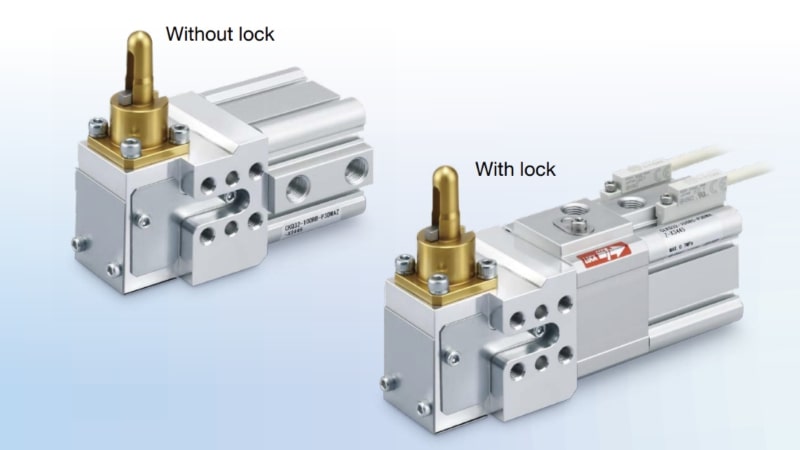
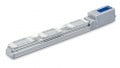
SMC’s pin clamp cylinder is available with and without a lock mechanism. Image used courtesy of SMC
Pin Clamp Cylinders
In automated assembly and welding, parts are required to be clamped in position while robots or humans work on the components. A pin clamp consists of a pin with a large lead-in; when activated, two small fingers protrude perpendicularly from the pin and lower to clamp the sheet metal component.
SMC’s new compact pin clamp cylinder is up to 94 mm shorter than other existing SMC pin clamps. This new, shorter design weighs only 560 g, resulting in a weight reduction of 38%. Two types of guide pins are offered: rounded and diamond. These different types allow for both restrictive and less restrictive locating features. Two types of sensors are compatible with the SMC pin clamp for sensing the position of the clamp: a magnetic field-resistant switch and a standard general-purpose switch.
A locking option is offered when used in applications where the clamped object is held in suspension. The locking mechanism is designed to prevent the workpiece from dropping in the event of an emergency stop condition.
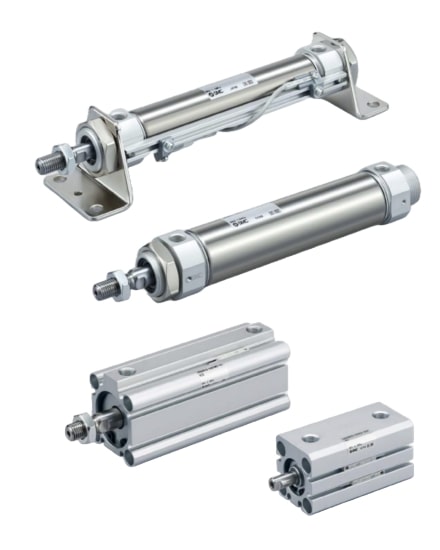
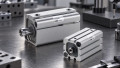
SMC’s round and square body high speed/high frequency cylinders. Image used courtesy of SMC
High Speed/High Frequency Cylinders
Some automation applications require cylinders to react quickly, such as with conveyor sorting applications. The cylinder needs to go from fully retracted to fully extended as fast as possible. SMC’s new CM2/CQ2 high speed/high frequency cylinders have a maximum piston speed of 2500 mm/s and a maximum operating frequency of 15 Hz. The new cylinders are 2000 mm/sec faster than similar SMC cylinders.
The new cylinders come in two styles: the CM2 is a tubular body, and the CQ2 is a square body. Both styles come in 20, 25, and 32 mm bore sizes and use a standard rubber cushion. The CM2 has stroke sizes of 25 to 100 mm and uses a basic foot bracket flange. The CQ2 comes in stroke sizes of 5 to 50 mm and uses a basic foot bracket and a compact foot bracket flange.

The CM2/CQ2 cylinders are designed to operate in applications that require high speeds, such as rejecting non-conforming objects on conveyors. Image used courtesy of Adobe Stock
Pneumatic Cylinders for High Speeds
Applications that use pneumatic cylinders often require a slow, controlled extend and retract action. Other applications, however, often require much faster actions, such as the case of objects moving down a conveyor. Sorting objects on a conveyor requires fast-acting pneumatics to push the objects onto other conveyors and retract before the following object reaches the cylinder. Controlling a typical cylinder in this fashion would commonly reduce the life span of the cylinder. A cylinder such as SMC’s new CQ2/CM2 is designed to reduce downtime for such high-speed applications.
Related Content