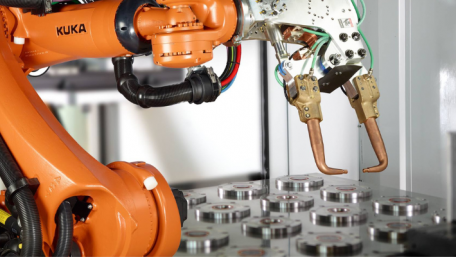
An EOAT, located at the end of an industrial or collaborative robot arm, is entirely customizable with nearly unlimited possibilities. Learn about the five main…
An EOAT, located at the end of an industrial or collaborative robot arm, is entirely customizable with nearly unlimited possibilities. Learn about the five main methods of how EOATs are powered and the sensors that they use.

Yaskawa announces the release of its long-reaching, six-axis GP8L robot for maximum productivity in limited spaces. With…
Yaskawa announces the release of its long-reaching, six-axis GP8L robot for maximum productivity in limited spaces. With easy installation and use in a variety of applications, the GP8L stands apart from similar products on the market.

Banner's new DXMR90-4K IO-Link Master is a self-contained programmable controller, compatible with industry IO-Link…
Banner's new DXMR90-4K IO-Link Master is a self-contained programmable controller, compatible with industry IO-Link standard devices to collect factory data to send directly into the cloud for different operations.

While B&R PLC controllers are quite different from typical PLCs, Automation Studio offers tools and features that make…
While B&R PLC controllers are quite different from typical PLCs, Automation Studio offers tools and features that make programming them less intensive. In this article, we’ll discuss how to program B&R PLCs with Automation Studio.

The ability to utilize an array effectively is a fundamental skill in becoming a PLC programmer, but it can also be very…
The ability to utilize an array effectively is a fundamental skill in becoming a PLC programmer, but it can also be very complex and difficult to master. Let’s do a run-down of arrays and some of their complexities!

In this article, we will take a look at the differences between synchronous and induction motors, as well as the two…
In this article, we will take a look at the differences between synchronous and induction motors, as well as the two types of induction motors: squirrel cage and wound rotor.

Robots are no longer unanimously just "robots"—there are specific tasks and functionality of each kind. Learn about the…
Robots are no longer unanimously just "robots"—there are specific tasks and functionality of each kind. Learn about the technology differences between fixed-location robots and mobile robots and why no one robot is like another.

Learn about the common applications, programming procedures, and safety protocols of collaborative robot work cells,…
Learn about the common applications, programming procedures, and safety protocols of collaborative robot work cells, which are often simpler and less expensive than industrial robot work cells.

Inside a controller, code is interpreted into the binary signals that influence input and output signals, flags and…
Inside a controller, code is interpreted into the binary signals that influence input and output signals, flags and registers, and even the communication of network signals. This is the job of firmware.

Fuses and breakers are some of the most common safeguards to prevent electrical shock and fires. Learn about these two…
Fuses and breakers are some of the most common safeguards to prevent electrical shock and fires. Learn about these two pieces of industrial equipment and the difference between slow blow and quick blow responses.

As logistics providers face increasing consumer demand and disruption, automation plays a key role in stabilizing the…
As logistics providers face increasing consumer demand and disruption, automation plays a key role in stabilizing the supply chain via future-facing integration and worker specialization.

The world of manufacturing is filled with robots, but beginners are still always faced with key questions, starting with…
The world of manufacturing is filled with robots, but beginners are still always faced with key questions, starting with perhaps the most basic: how do you program industrial robots?

Centralized control systems are often seen as outdated compared to decentralized systems; however, both have their…
Centralized control systems are often seen as outdated compared to decentralized systems; however, both have their advantages and disadvantages when it comes to choosing which one to use in manufacturing.

DC voltage systems exist to provide controllers and field devices with stable power, but it is not always clear when…
DC voltage systems exist to provide controllers and field devices with stable power, but it is not always clear when these systems should be bonded with the earth ground of the AC line voltage supply.

Programmable Logic Control (PLC) systems are the core of most industrial control systems that drive modern manufacturing.…
Programmable Logic Control (PLC) systems are the core of most industrial control systems that drive modern manufacturing. In this Control Automation video, we discuss the important hardware elements that define a PLC, regardless of its size or purpose.

Programmable Logic Control (PLC) systems are the core of most industrial control systems that drive modern manufacturing.…
Programmable Logic Control (PLC) systems are the core of most industrial control systems that drive modern manufacturing. In our Control.com video tutorials, we will share information, experience, and tips for working with PLCs—from the hardware, to the wiring, to the programming logic of inputs, outputs, and communication processes.

One of the most considerable risks in aging control environments is that eventually, spare parts become obsolete and…
One of the most considerable risks in aging control environments is that eventually, spare parts become obsolete and unavailable, and the lack of an upgrade plan can turn a simple failure into a catastrophe.

In honor of May the 4th, Star Wars Day, we compare the sources and applications of the two most common force-delivery…
In honor of May the 4th, Star Wars Day, we compare the sources and applications of the two most common force-delivery systems - mechanical and hydraulic.

Two common methods exist for driving induction motors with VFDs - linear scalar control, which is often labeled as V/f,…
Two common methods exist for driving induction motors with VFDs - linear scalar control, which is often labeled as V/f, and vector, or field-oriented control, which can be a bit more complex to understand.

Large DC and AC motor drives often provide terminals for installing a braking resistor. What are these resistors, and how…
Large DC and AC motor drives often provide terminals for installing a braking resistor. What are these resistors, and how do they slow down a machine? What hazards and cautions must be considered?

 Facebook
 Google
 GitHub
 Linkedin