Facebook
 Google
 GitHub
 Linkedin
Instrumentation and Process Control
Pressure-based Flowmeter Calculations
7 questions
-
Question 1 of 7
A pitot tube measuring the flow of glycerin (78.6 lb/ft$^{3}$) produces a differential pressure of 35 “WC (inches of water column) at a mass flow rate of 450 pounds per minute.
Calculate the differential pressure produced by this same Pitot tube at a flow rate of 310 lb/min.
Calculate the mass flow rate at a differential pressure of 12.6 “WC.
If the glycerin density happens to change from 78.6 lb/ft$^{3}$ to 75.1 lb/ft$^{3}$, calculate the mass flow rate at a differential pressure of 24.8 “WC.
Reveal answerDifferential pressure produced by this same Pitot tube at a flow rate of 310 lb/min = 16.61 “WC
Mass flow rate at a differential pressure of 12.6 “WC = 270 lb/min
Mass flow rate at DP of 24.8 “WC, assuming a density of 75.1 lb/ft$^{3}$ = 370.3 lb/min
-
Question 2 of 7
A pneumatic DP transmitter measures the flow of gasoline through a an orifice plate, using a separate square root extractor relay to characterize the signal so that it may be displayed linearly on the receiver gauge (FI-20):
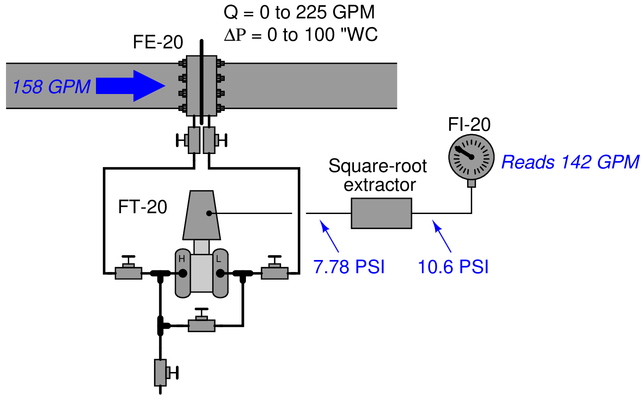
Based on other flow-measuring devices in this process, operations personnel have determined the actual flow rate through this pipe is 158 gallons per minute. FI-20, however, registers a flow of 142 gallons per minute. Based on the data you see in this illustration, determine the location of the calibration error.
Reveal answerThe error lies either with the DP transmitter (FT-20), unequal fluid inside the impulse tubes, or with the orifice plate itself (FE-20). One quick check would be to drain the impulse tubes (allowing fresh process gasoline to fill the tubes) and seeing whether that fixes the problem. It’s a quick procedure and it would eliminate that problem from the realm of possibility.
Another way to diagnose the problem is to remove FT-20 from service and test its calibration with applied pressures to its “H” side port. If FT-20 checks out okay, the problem must be with the impulse tubes or the orifice plate.
-
Question 3 of 7
A pneumatic DP transmitter measures the flow of gasoline through a an orifice plate, using a separate square root extractor relay to characterize the signal so that it may be displayed linearly on the receiver gauge (FI-20):
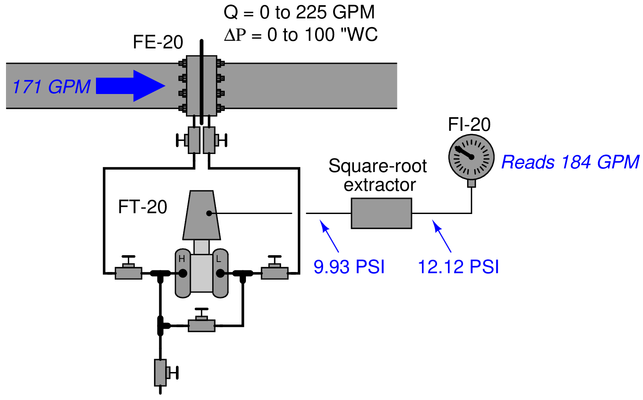
Based on other flow-measuring devices in this process, operations personnel have determined the actual flow rate through this pipe is 171 gallons per minute. FI-20, however, registers a flow of 184 gallons per minute. Based on the data you see in this illustration, determine the location of the calibration error.
Reveal answerThe error lies with the indicator (FI-20).