Facebook
 Google
 GitHub
 Linkedin
Electricity and Electronics
Fault Analysis of Simple Circuits
75 questions
-
Question 1 of 75
Suppose a voltmeter registers 0 volts between test points C and F, but measures 24 volts between those same test points when the connection between B and C is broken:
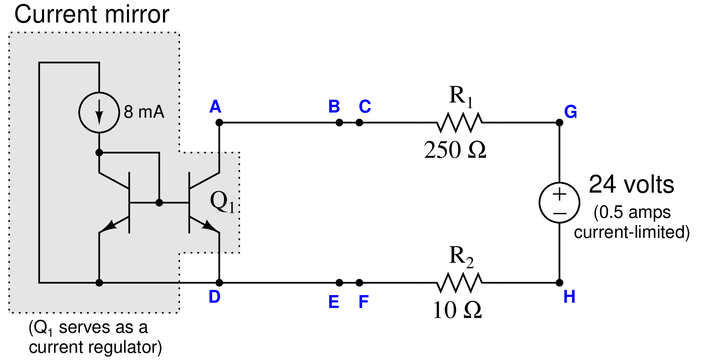
Identify the likelihood of each specified fault for this circuit. Consider each fault one at a time (i.e. no coincidental faults), determining whether or not each fault could independently account for all measurements and symptoms in this circuit.
$$\begin{array} {|l|l|} \hline Fault & Possible & Impossible \\ \hline R_1~Failed~open & & \\ \hline R_2~Failed~open & & \\ \hline Q_1~Failed~open & & \\ \hline R_1~Failed~shorted & & \\ \hline R_2~Failed~shorted & & \\ \hline Q_1~Failed~shorted & & \\ \hline Voltage~source~dead & & \\ \hline \end{array}$$
Reveal answer$$\begin{array} {|l|l|} \hline Fault & Possible & Impossible \\ \hline R_1~Failed~open & & \surd \\ \hline R_2~Failed~open & & \surd \\ \hline Q_1~Failed~open & & \surd \\ \hline R_1~Failed~shorted & & \surd \\ \hline R_2~Failed~shorted & & \surd \\ \hline Q_1~Failed~shorted & \surd & \\ \hline Voltage~source~dead & & \surd \\ \hline \end{array}$$
-
Question 2 of 75
Suppose this electric-driven air compressor cycles between 60 PSI and 105 PSI when the switch is in the “Auto” position, and cycles between 102 PSI and 105 PSI when in the “Hand” position:
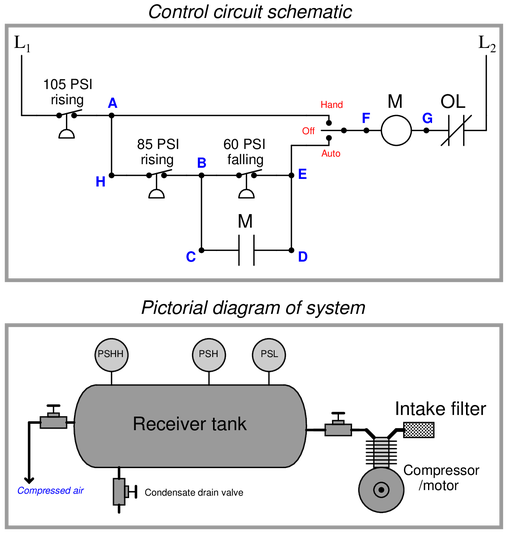
Identify the likelihood of each specified fault for this circuit. Consider each fault one at a time (i.e. no coincidental faults), determining whether or not each fault could independently account for all measurements and symptoms in this circuit.
$$\begin{array} {|l|l|} \hline Fault & Possible & Impossible \\ \hline PSHH~Failed~open & & \\ \hline PSH~Failed~open & & \\ \hline PSL~Failed~open & & \\ \hline Aux~“M”~contact~failed~open & & \\ \hline PSHH~Failed~shorted & & \\ \hline PSH~Failed~shorted & & \\ \hline PSL~Failed~shorted & & \\ \hline Aux~“M”~contact~failed~shorted & & \\ \hline \end{array}$$
Reveal answer$$\begin{array} {|l|l|} \hline Fault & Possible & Impossible \\ \hline PSHH~Failed~open & & \surd \\ \hline PSH~Failed~open & & \surd \\ \hline PSL~Failed~open & & \surd \\ \hline Aux~“M”~contact~failed~open & & \surd \\ \hline PSHH~Failed~shorted & & \surd \\ \hline PSH~Failed~shorted & \surd & \\ \hline PSL~Failed~shorted & & \surd \\ \hline Aux~“M”~contact~failed~shorted & & \surd \\ \hline \end{array}$$
Notes:This question is a good candidate for a “Virtual Troubleshooting” exercise. Presenting the diagram to students, you first imagine in your own mind a particular fault in the system. Then, you present one or more symptoms of that fault (something noticeable by an operator or other user of the system). Students then propose various diagnostic tests to perform on this system to identify the nature and location of the fault, as though they were technicians trying to troubleshoot the problem. Your job is to tell them what the result(s) would be for each of the proposed diagnostic tests, documenting those results where all the students can see.
During and after the exercise, it is good to ask students follow-up questions such as:
{\bullet} What does the result of the last Diagnostic~test tell you about the fault?
{\bullet} Suppose the results of the last Diagnostic~test were different. What then would that result tell you about the fault?
{\bullet} Is the last Diagnostic~test the best one we could do?
{\bullet} What would be the ideal order of tests, to diagnose the problem in as few steps as possible? -
Question 3 of 75
Suppose this electric-driven air compressor refuses to start when the switch is in the “Auto” position, but starts up immediately when the switch is placed in the “Hand” position. The first test performed by a technician is to measure AC voltage between test points A and F with the switch in the “Auto” position. There, the meter registers 117 volts AC. You are then called in to help:
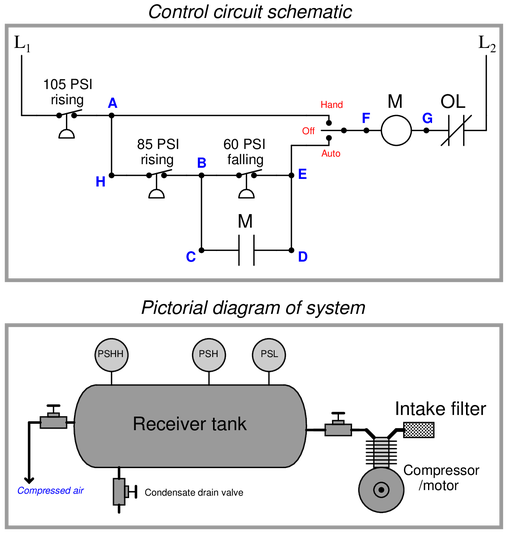
Identify the likelihood of each specified fault for this circuit. Consider each fault one at a time (i.e. no coincidental faults), determining whether or not each fault could independently account for all measurements and symptoms in this circuit.
$$\begin{array} {|l|l|} \hline Fault & Possible & Impossible \\ \hline PSHH~Failed~open & & \\ \hline PSH~Failed~open & & \\ \hline PSL~Failed~open & & \\ \hline “Hand”~switch~position~failed~open & & \\ \hline “Auto”~switch~position~failed~open & & \\ \hline OL~contact~failed~open & & \\ \hline Aux~“M”~contact~failed & & \\ \hline Contactor~“M”~coil~failed~open & & \\ \hline \end{array}$$
Reveal answer$$\begin{array} {|l|l|} \hline Fault & Possible & Impossible \\ \hline PSHH~Failed~open & & \surd \\ \hline PSH~Failed~open & \surd & \\ \hline PSL~Failed~open & \surd & \\ \hline “Hand”~switch~position~failed~open & & \surd \\ \hline “Auto”~switch~position~failed~open & \surd & \\ \hline OL~contact~failed~open & & \surd \\ \hline Aux~“M”~contact~failed & & \surd \\ \hline Contactor~“M”~coil~failed~open & & \surd \\ \hline \end{array}$$
Notes:This question is a good candidate for a “Virtual Troubleshooting” exercise. Presenting the diagram to students, you first imagine in your own mind a particular fault in the system. Then, you present one or more symptoms of that fault (something noticeable by an operator or other user of the system). Students then propose various diagnostic tests to perform on this system to identify the nature and location of the fault, as though they were technicians trying to troubleshoot the problem. Your job is to tell them what the result(s) would be for each of the proposed diagnostic tests, documenting those results where all the students can see.
During and after the exercise, it is good to ask students follow-up questions such as:
{\bullet} What does the result of the last Diagnostic~test tell you about the fault?
{\bullet} Suppose the results of the last Diagnostic~test were different. What then would that result tell you about the fault?
{\bullet} Is the last Diagnostic~test the best one we could do?
{\bullet} What would be the ideal order of tests, to diagnose the problem in as few steps as possible?