
 Facebook
 Google
 GitHub
 Linkedin
Electricity and Electronics
Basic Circuit Troubleshooting
21 questions
-
Question 1 of 21
Determine the statuses of all lamps and relay coils in this circuit, given the following process conditions:

{\bullet} Flow = 3.5 GPM
{\bullet} Pressure = 41 PSI
{\bullet} Temperature = 155 °F
{\bullet} Level = 1.3 ft
{\bullet} Pushbutton A = unpressed
{\bullet} Pushbutton B = unpressedReveal answerFully annotated circuit schematic:
“X” represents an open contact or de-energized load
“{\rightarrow}” represents a closed contact or energized load}
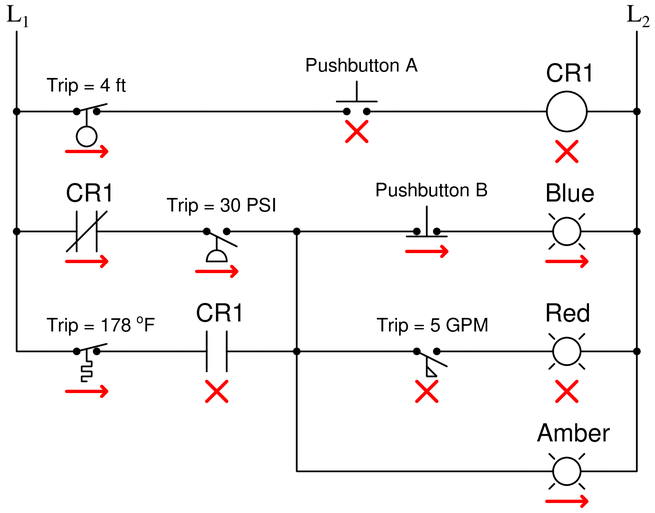
Recall that a process switch will be in its resting (“normal”) condition when the stimulus value is less than the trip threshold, and will be in its actuated condition when the stimulus exceeds the threshold.
Therefore,
{\bullet} CR1 coil = de-energized
{\bullet} Blue lamp = energized
{\bullet} Red lamp = de-energized
{\bullet} Amber lamp = energizedNotes:Reference educational links:
- Relay circuits and ladder diagrams
- Ladder diagram structures
- NO and NC electrical symbols
- Understanding NO and NC contacts
-
Question 2 of 21
A form of liquid level switch called a tilt switch is often used for detecting sewage level in “lift stations” where sewage collected from homes via gravity is pumped out of the collection sump to the wastewater treatment plant (usually located miles away):

Tilt switches often use a small glass vial containing liquid mercury as the tilt sensor. Explain how a glass tube partially filled with mercury works as an electrical tilt switch, and also perform a “thought experiment” where you describe this system’s function from start to finish through a complete start-stop cycle of the pump motor:
{\bullet} What would happen if the OL switch failed open in this system?
{\bullet} What would happen if the LSL switch failed open in this system?
{\bullet} What would happen if the LSH switch failed open in this system?
{\bullet} What would happen if the LSL switch failed shorted in this system?
{\bullet} What would happen if the LSH switch failed shorted in this system?
{\bullet} What would happen if the LSH switch failed shorted in this system?
{\bullet} What would happen if the M1 seal-in contact failed open in this system?
{\bullet} What would happen if the M1 seal-in contact failed shorted in this system?Reveal answerA mercury “tilt switch” uses a sample of liquid mercury metal to bridge wire contacts inside of a sealed glass tube when the tube is tipped in a certain direction.
Thought experiment:
{\bullet} Sump starts empty
{\bullet} Level begins to rise
{\bullet} LSL switch tilts; motor doesn’t start up yet because LSH is still open
{\bullet} LSH switch tilts; motor starts up
{\bullet} Level begins to drop as pump moves wastewater out of sump
{\bullet} LSH returns to normal; motor continues to run because it’s control circuit is “sealed in”
{\bullet} LSL retuns to normal; motor stops and remains off until LSH tips againPredicting the effect of a given fault:
Present each of the following faults to the students, one at a time, having them comment on all the effects each fault would produce.
Identifying possible/impossible faults:
Present symptoms to the students and then have them determine whether or not a series of suggested faults could account for all the symptoms, explaining why or why not for each proposed fault:
{\bullet} Symptom:
{\bullet} — Yes/No
{\bullet} — Yes/No
{\bullet} — Yes/NoDetermining the utility of given diagnostic tests:
Present symptoms to the students and then propose the following diagnostic tests one by one. Students rate the value of each test, determining whether or not it would give useful information (i.e. tell us something we don’t already know). Students determine what different results for each test would indicate about the fault, if anything:
{\bullet} Symptom:
{\bullet} — Yes/No
{\bullet} — Yes/NoDiagnosing a fault based on given symptoms:
Imagine the LSH fails shorted in this system (don’t reveal the fault to students!). Present the operator’s observation(s) to the students, have them consider possible faults and diagnostic strategies, and then tell them the results of tests they propose based on the following symptoms, until they have properly identified the nature and location of the fault:
{\bullet} The pump keeps cycling on and off at the low-level switch’s height.
Notes:Be sure to review the operation of the simple motor start-stop circuit in your answer!
————————
Reference educational links:
-
Question 3 of 21
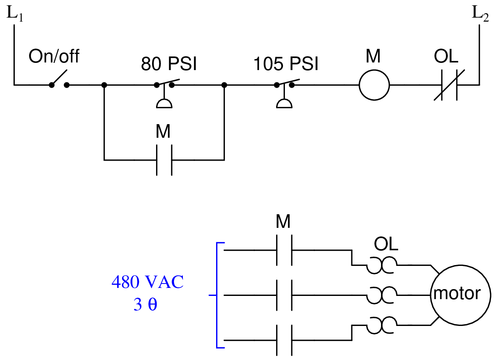
Draw a ladder logic control circuit for the electric motor of an air compressor, controlled by two pressure switches: one switch turns the motor on when the pressure falls to 80 PSI, while the other switch turns the motor off when the pressure rises to 105 PSI:

Be sure to include the overload (OL) contact in the 120 volt control circuit (L1 & L2), and include a manual on/off switch as well.


Thanks. This is an insteresting set of questions.