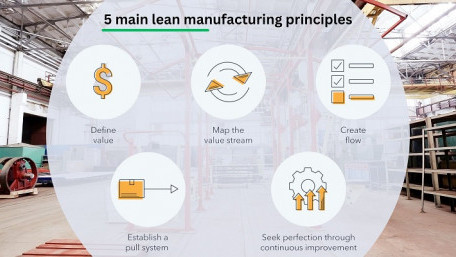
The Lean process uses a method of implementation focusing only on actions providing value to customers. The following five steps break down the process into…
The Lean process uses a method of implementation focusing only on actions providing value to customers. The following five steps break down the process into discrete modules when introducing efficiency to production.

Setting and resetting a PLC output is essential in establishing a holding circuit for a transducer. Learn how to use…
Setting and resetting a PLC output is essential in establishing a holding circuit for a transducer. Learn how to use set/reset instructions in MELSOFT series GX Works2 to latch and release an output.

Hydraulic pumps take energy from a source, usually an electric motor or combustion engine, and turn it into a usable…
Hydraulic pumps take energy from a source, usually an electric motor or combustion engine, and turn it into a usable force to complete work. What kind of hydraulic pumps exist, and how do they work?

Industrial and robotics cabling requires specialized termination strategies. This article introduces connectors involved…
Industrial and robotics cabling requires specialized termination strategies. This article introduces connectors involved in automation applications for cable-to-cable or cable-to-device termination.

Any kind of computer programming can be challenging to determine what aspects are truly unique versus what aspects should…
Any kind of computer programming can be challenging to determine what aspects are truly unique versus what aspects should be standardized across projects and platforms to streamline future development.

System dynamics is primarily concerned with understanding complex systems’ behaviors over time. Mathematical and…
System dynamics is primarily concerned with understanding complex systems’ behaviors over time. Mathematical and computer models can help identify responses before turning to costly real-world experiments.

Engineers face a common challenge of moving objects from one point to another, especially in a production line. This…
Engineers face a common challenge of moving objects from one point to another, especially in a production line. This article will introduce the pneumatic cylinder as used in industrial automation.

We see smoke detectors on a daily basis in every house and building we visit, but the same sensor elements, and others,…
We see smoke detectors on a daily basis in every house and building we visit, but the same sensor elements, and others, can be used to detect the presence of harmful gasses and heat in all industries.

Radiation, despite its reputation in pop culture as a harmful emission resulting from a natural disaster, is a property…
Radiation, despite its reputation in pop culture as a harmful emission resulting from a natural disaster, is a property of many materials and processes and must be carefully monitored for quality and safety.

Mitsubishi's FX series PLC is one of MELSOFT GX Developer’s most popular automation solutions for small and…
Mitsubishi's FX series PLC is one of MELSOFT GX Developer’s most popular automation solutions for small and medium-scale applications. Learn how to use GX Developer software to program the FX series PLC.

Rubber belts have lived under the hood of nearly every car since they first took to the streets, but they also transmit…
Rubber belts have lived under the hood of nearly every car since they first took to the streets, but they also transmit power through all kinds of industrial machine drives as well.

Vibration sensors measure the mechanical vibration of an object, making it possible to monitor machines for early signs…
Vibration sensors measure the mechanical vibration of an object, making it possible to monitor machines for early signs of failure to prevent costly and dangerous breakdowns.

Hydraulic systems suffer from pressure drops and energy loss whenever any fluid is in motion. Learn about these devices…
Hydraulic systems suffer from pressure drops and energy loss whenever any fluid is in motion. Learn about these devices called ‘accumulators’. What are they, how do they work, and why do we need them?

Understanding torque is a key method of preventing damage to machines and ensuring a long lifespan. We have all heard of…
Understanding torque is a key method of preventing damage to machines and ensuring a long lifespan. We have all heard of torque, but what is it, and how is it measured in automated systems?

AutomationDirect’s Productivity line of PLCs is known for cost-effectiveness and ease of use. Learn how to build and…
AutomationDirect’s Productivity line of PLCs is known for cost-effectiveness and ease of use. Learn how to build and download a simple program using discrete input and output ladder commands.

Limit switches are electromechanical devices that open or close contacts when external pressure is applied to an…
Limit switches are electromechanical devices that open or close contacts when external pressure is applied to an actuator. This solves a simple problem faced by motion devices: limiting movement

Engineering processes like robotics, feedback control, and security systems rely on position and distance sensors to…
Engineering processes like robotics, feedback control, and security systems rely on position and distance sensors to provide real-time information that enables machines to operate accurately and safely.

Fluid flow control is often crucial to control systems and can be achieved by incorporating control valves. In this…
Fluid flow control is often crucial to control systems and can be achieved by incorporating control valves. In this article, we will look at the sequence valve and its use in systems to automate fluid flow.

Although electrical systems often receive the highest praise for advancement, precision, and technological innovation,…
Although electrical systems often receive the highest praise for advancement, precision, and technological innovation, the world would be stuck without mechanical power delivery systems like gear drives.

Flow sensors measure the flow rate of liquids or gasses in pipes, ducts, and other fluid systems to help monitor and…
Flow sensors measure the flow rate of liquids or gasses in pipes, ducts, and other fluid systems to help monitor and control processes, prevent system failures, and optimize performance.

 Facebook
 Google
 GitHub
 Linkedin