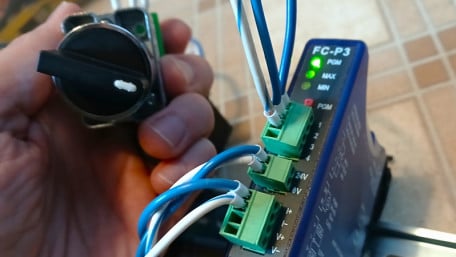
There aren’t actually all that many industrial I/O signal types, and most sensors are designed to output just the right type of signal. But… How do we deal…
There aren’t actually all that many industrial I/O signal types, and most sensors are designed to output just the right type of signal. But… How do we deal with those pesky potentiometers?

While mechanical wear in rotating machinery may be obvious over time, electrical faults can also cause bearings to fail.…
While mechanical wear in rotating machinery may be obvious over time, electrical faults can also cause bearings to fail. Unfortunately, the symptoms can look surprisingly similar.

This guide examines common ladder logic structures and presents the equivalent structured text representation, mainly…
This guide examines common ladder logic structures and presents the equivalent structured text representation, mainly intended as a learning guide for those getting started with ST.

Accelerating motors is a tricky topic, with profiles ranging from step inputs to polynomials. Which profile is the best…
Accelerating motors is a tricky topic, with profiles ranging from step inputs to polynomials. Which profile is the best choice, and why?

Encoders rely on high-speed outputs supplying signals to a PLC. Learn why these signals cannot be interchanged at will,…
Encoders rely on high-speed outputs supplying signals to a PLC. Learn why these signals cannot be interchanged at will, and some best practices for preventing false rotational counts.

Ladder logic is the legendary industrial graphical programming language that once resembled electrical drawings, but it…
Ladder logic is the legendary industrial graphical programming language that once resembled electrical drawings, but it has advanced far beyond a collection of digital electrical symbols.

Wire nuts? Soldering? Terminal blocks? Learn what the UL508 standard says about the acceptable types of wiring…
Wire nuts? Soldering? Terminal blocks? Learn what the UL508 standard says about the acceptable types of wiring connections for industrial control panels.

Connecting to equipment remotely can save time and travel expenses. It is a powerful tool, but with great power comes…
Connecting to equipment remotely can save time and travel expenses. It is a powerful tool, but with great power comes great responsibility.

Get ready for a control-themed roller coaster ride, pitting two PLCs against one Modbus I/O rack, and you might be…
Get ready for a control-themed roller coaster ride, pitting two PLCs against one Modbus I/O rack, and you might be shocked at the results: Who will win… And who will lose?

Learn how to configure the connection for a Mitsubishi FX5UC controller over Ethernet using GX Works 3.
Learn how to configure the connection for a Mitsubishi FX5UC controller over Ethernet using GX Works 3.

When motors drive in parallel from a single main power source, do they each need an individual VFD? Check out why this is…
When motors drive in parallel from a single main power source, do they each need an individual VFD? Check out why this is useful in some cases, and take note of some necessary precautions.

Predictive maintenance brings real cost and time savings, but there can be a lot of confusion when setting up a system.…
Predictive maintenance brings real cost and time savings, but there can be a lot of confusion when setting up a system. Control.com talks to the experts at NORD, a motor specialist, to learn more.

Requiring multiple AC motors to start simultaneously is a common need for conveyors within manufacturing plants, but can…
Requiring multiple AC motors to start simultaneously is a common need for conveyors within manufacturing plants, but can we really reduce costs and panel space by eliminating redundant components?

In this tutorial, we add remote I/O to a Studio 5000 project using Modbus TCP and the new SLM System from Synergy Logic,…
In this tutorial, we add remote I/O to a Studio 5000 project using Modbus TCP and the new SLM System from Synergy Logic, which promises to simplify the integration. We’ll see how it lives up.

Addressing variables at the bit level can save precious PLC memory as well as make your code more readable and easier to…
Addressing variables at the bit level can save precious PLC memory as well as make your code more readable and easier to understand.

Part 1 of a 2-part series. A practical look at the failures that plague motor drive systems, even those that are rated to…
Part 1 of a 2-part series. A practical look at the failures that plague motor drive systems, even those that are rated to be fail-safe.

Learn how to align and configure the parameters of a light curtain using a send/receive pair of SICK deTec4 light beam…
Learn how to align and configure the parameters of a light curtain using a send/receive pair of SICK deTec4 light beam curtains and the new DCM4 extension module for advanced operating modes.

Some safety applications aren’t a simple on/off at all times; they need objects to pass through a light curtain without…
Some safety applications aren’t a simple on/off at all times; they need objects to pass through a light curtain without stopping the machine. For these, we turn to muting and blanking features.

Learn about safety light curtains: which one will fit your application, how to choose the proper size, and how to…
Learn about safety light curtains: which one will fit your application, how to choose the proper size, and how to properly process the output signals.

Although ‘HMI’ has become synonymous with a durable, rugged touchscreen measuring 7 to 21 inches and mounted in a…
Although ‘HMI’ has become synonymous with a durable, rugged touchscreen measuring 7 to 21 inches and mounted in a control cabinet door, the reality of the interface extends far beyond this device.


 Facebook
 Google
 GitHub
 Linkedin