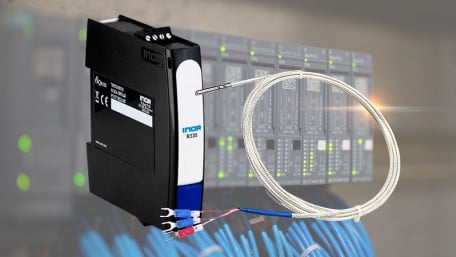
Learn how to measure temperature using an RTD and a temperature transmitter to convert resistance into common analog voltage or current values for process control.
Learn how to measure temperature using an RTD and a temperature transmitter to convert resistance into common analog voltage or current values for process control.

Learn how to control servo motors from a PLC using Allen-Bradley servos and Rockwell Automation’s Studio 5000 using a…
Learn how to control servo motors from a PLC using Allen-Bradley servos and Rockwell Automation’s Studio 5000 using a simple-to-understand method.

Creating custom alarm systems can be complicated and overwhelming, but they can also be very beneficial for equipment…
Creating custom alarm systems can be complicated and overwhelming, but they can also be very beneficial for equipment builders and integrators. Follow along as we build a custom alarm handling system.

Installing sensors into a manufacturing process is intended to collect data, useful in making logical true/false…
Installing sensors into a manufacturing process is intended to collect data, useful in making logical true/false decisions. But what settings must be adjusted when you install these sensors?

Version control software allows manufacturers to automatically save code revisions across teams. Learn how Automation NTH…
Version control software allows manufacturers to automatically save code revisions across teams. Learn how Automation NTH leveraged this strategy to save countless hours and increase reliability.

Using a Raspberry Pi and the OpenPLC software platform, create a simple PLC that can be programmed in ladder diagrams…
Using a Raspberry Pi and the OpenPLC software platform, create a simple PLC that can be programmed in ladder diagrams with remote access and I/O monitoring dashboards.

What is pressure? Everybody knows about this important quantity, but how do you define it? How do you measure it? Where…
What is pressure? Everybody knows about this important quantity, but how do you define it? How do you measure it? Where does it come from? In this article, we’ll learn about the basics of pressure.

This article investigates the basic components and wiring conventions for common three-phase motor starter…
This article investigates the basic components and wiring conventions for common three-phase motor starter configurations, including direct online, reversing, and star-delta.

This article investigates the basic qualities that make up a safety PLC, what distinguishes a safety PLC from a standard…
This article investigates the basic qualities that make up a safety PLC, what distinguishes a safety PLC from a standard model, and the reasons for which a safety PLC may be critical.

Electrical and mechanical measurements are often labeled with "RMS" and "True RMS." Aside from the simple math…
Electrical and mechanical measurements are often labeled with "RMS" and "True RMS." Aside from the simple math definitions we learned in electronics class, why is this distinction actually important?

Have you ever heard of a relay? Of course you have. There are many different kinds, plus hundreds of different trade…
Have you ever heard of a relay? Of course you have. There are many different kinds, plus hundreds of different trade lingo names. What are some of the most common, and how do we use them?

Knowing what kind of control system to use: that’s a question that must be answered before setting up the factory…
Knowing what kind of control system to use: that’s a question that must be answered before setting up the factory floor. Why would someone choose pneumatic over electrical controls?

Safety devices have two main purposes, both of them meant for (you guessed it) safety. They protect both machine and…
Safety devices have two main purposes, both of them meant for (you guessed it) safety. They protect both machine and operator from harm. But what’s inside, and how do these switches work?

Within motors, two very different types of resistance are evident. The resistance of the windings is measured with a…
Within motors, two very different types of resistance are evident. The resistance of the windings is measured with a normal multimeter. But what is insulation resistance, and how is it measured?

In order to trace control system problems to the core, the ability to read and interpret various resources, from…
In order to trace control system problems to the core, the ability to read and interpret various resources, from facility-level diagrams to machine-level wiring layouts, is critical.

Converting different numbering systems is quite common in PLCs and structured text codes. Why? Because people read…
Converting different numbering systems is quite common in PLCs and structured text codes. Why? Because people read decimals. Computers read binary. Processors read sets of bits. Not so simple.

It’s important to consider your PLC tag naming convention when using different styles. Learn when and why you might…
It’s important to consider your PLC tag naming convention when using different styles. Learn when and why you might even use more than one, depending on the circumstances and scope of your project.

For large process systems, learn how the location of data indication and flag processing can increase or decrease the…
For large process systems, learn how the location of data indication and flag processing can increase or decrease the burden on computers at the device, RTU, or main computer level.

Rockwell Automation’s Allen-Bradley control hardware catalog has long included many series that start with 17xx, but…
Rockwell Automation’s Allen-Bradley control hardware catalog has long included many series that start with 17xx, but what are these lineups, and what function do they serve?

Choosing the right connector for industrial applications is no small feat. This article will discuss factors you must…
Choosing the right connector for industrial applications is no small feat. This article will discuss factors you must consider, including electrical, mechanical, and shape.


 Facebook
 Google
 GitHub
 Linkedin