This article features an in-depth discussion of the various options for buttons and switches, including function, styles, shapes, and illumination options for…
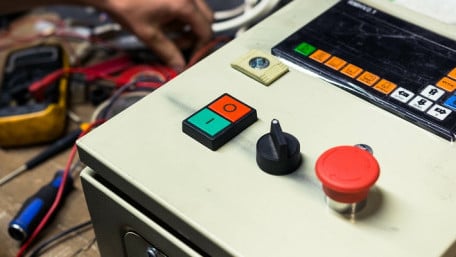
This article features an in-depth discussion of the various options for buttons and switches, including function, styles, shapes, and illumination options for all kinds of control panel inputs.

We usually think of joysticks in terms of video game controllers, but they exist in all kinds of industrial systems:…
We usually think of joysticks in terms of video game controllers, but they exist in all kinds of industrial systems: heavy equipment, overhead cranes, and even some robotic controls. But how do they work?

Variable control allows external conditions, like temperature, to be monitored so the controller can activate devices to…
Variable control allows external conditions, like temperature, to be monitored so the controller can activate devices to heat or cool the system as needed. Simulate a temp controller with low-cost components!

Designing, installing, and maintaining control systems involves a lot of wires. Each wire has a purpose, often indicated…
Designing, installing, and maintaining control systems involves a lot of wires. Each wire has a purpose, often indicated by the color of the insulation. But what are the common colors, and what do they mean?

Limit switches are electromechanical devices that open or close contacts when external pressure is applied to an…
Limit switches are electromechanical devices that open or close contacts when external pressure is applied to an actuator. This solves a simple problem faced by motion devices: limiting movement

Learn about the history, framework, and current uses of the Open Platform Communications United Architecture (OPC UA)…
Learn about the history, framework, and current uses of the Open Platform Communications United Architecture (OPC UA) communication protocol in industrial automation.

The subject of grounding in electronics is broad and complex, spanning across a variety of functions and objectives. In…
The subject of grounding in electronics is broad and complex, spanning across a variety of functions and objectives. In this article, we will investigate the applications and regulation of grounding in control systems on a fundamental level.

Field-oriented control (FOC), also called vector control, can control 3-phase alternating current motors and brushless DC…
Field-oriented control (FOC), also called vector control, can control 3-phase alternating current motors and brushless DC motors. Read more to learn its advantages, how it works, and its best applications.

Large motors require a circuit to turn on and off. This may be as simple as a single on/off drum-type switch or as…
Large motors require a circuit to turn on and off. This may be as simple as a single on/off drum-type switch or as elaborate as a VFD unit. Learn about some common control circuit designs for typical three-phase motor requirements.

EMC-compliant panels are an excellent first step in reducing electromagnetic interference from industrial control…
EMC-compliant panels are an excellent first step in reducing electromagnetic interference from industrial control systems. Learn about some features of electromagnetic compatibility in panels.

Using symbols instead of text provides a fast and effective way to describe an electrical system. Learn about the what,…
Using symbols instead of text provides a fast and effective way to describe an electrical system. Learn about the what, when, where, and why of commonly used electrical symbols from the perspective of a controls engineer.

Machine safety design can be a daunting task with all the different safety devices on the market today. Choosing the…
Machine safety design can be a daunting task with all the different safety devices on the market today. Choosing the correct device for your design can be made easier by understanding when to use the proper device.

We are taught that parallel circuits maintain equal voltage across all branch resistors, equally sharing the source…
We are taught that parallel circuits maintain equal voltage across all branch resistors, equally sharing the source voltage. But reality is often far from ideal, and individual devices certainly impact the rest of the circuit.

Designing a system with motor motion always includes a consideration of safety. Incorporating safety contactors might be…
Designing a system with motor motion always includes a consideration of safety. Incorporating safety contactors might be the correct prevention to protect equipment and users but may add additional challenges.

Closed-loop motor control is a control system used to regulate the output of a motor. Learn about the four common types…
Closed-loop motor control is a control system used to regulate the output of a motor. Learn about the four common types of closed-loop motor control systems to understand each one’s inner-workings and applications.

PLCs and microprocessors have largely replaced timing functions in control circuits. But these timer relays still hold…
PLCs and microprocessors have largely replaced timing functions in control circuits. But these timer relays still hold many necessary tasks. What’s inside these devices might be more complex than you imagined!

Coil, field winding, rotor, stator, eddy current… When it comes to motors, there are numerous terms that describe the…
Coil, field winding, rotor, stator, eddy current… When it comes to motors, there are numerous terms that describe the theory of operation, but what is inside a 3-phase motor? Take a look, and learn how they work.

Frequency filters remove unwanted variations from signals and power sources. In this article, we explore why we need…
Frequency filters remove unwanted variations from signals and power sources. In this article, we explore why we need frequency filters in industrial automation and where they are commonly found.

Safety is one of the most critical aspects of machine design. Today, with network connections between different machines…
Safety is one of the most critical aspects of machine design. Today, with network connections between different machines and control centers, safety signals must be shared logically and reliably across networks.

Protection systems are critical in today’s fast-paced industrial revolution for the safety of people and processes.…
Protection systems are critical in today’s fast-paced industrial revolution for the safety of people and processes. This article discusses electronic protective relay types and how they differ from standard relays.


 Facebook
 Google
 GitHub
 Linkedin