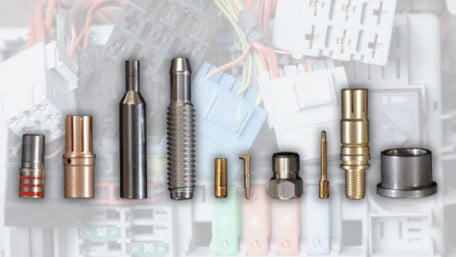
Selecting a suitable electrical connector is a process that is based on how you will terminate it to the system. This article provides advice on how to make the…
Selecting a suitable electrical connector is a process that is based on how you will terminate it to the system. This article provides advice on how to make the right contact selection for your industrial or robotic system.

Industrial and robotics cabling requires specialized termination strategies. This article introduces connectors involved…
Industrial and robotics cabling requires specialized termination strategies. This article introduces connectors involved in automation applications for cable-to-cable or cable-to-device termination.

This article features an in-depth discussion of the various options for buttons and switches, including function, styles,…
This article features an in-depth discussion of the various options for buttons and switches, including function, styles, shapes, and illumination options for all kinds of control panel inputs.

We usually think of joysticks in terms of video game controllers, but they exist in all kinds of industrial systems:…
We usually think of joysticks in terms of video game controllers, but they exist in all kinds of industrial systems: heavy equipment, overhead cranes, and even some robotic controls. But how do they work?

Variable control allows external conditions, like temperature, to be monitored so the controller can activate devices to…
Variable control allows external conditions, like temperature, to be monitored so the controller can activate devices to heat or cool the system as needed. Simulate a temp controller with low-cost components!

Designing, installing, and maintaining control systems involves a lot of wires. Each wire has a purpose, often indicated…
Designing, installing, and maintaining control systems involves a lot of wires. Each wire has a purpose, often indicated by the color of the insulation. But what are the common colors, and what do they mean?

Limit switches are electromechanical devices that open or close contacts when external pressure is applied to an…
Limit switches are electromechanical devices that open or close contacts when external pressure is applied to an actuator. This solves a simple problem faced by motion devices: limiting movement

Learn about the history, framework, and current uses of the Open Platform Communications United Architecture (OPC UA)…
Learn about the history, framework, and current uses of the Open Platform Communications United Architecture (OPC UA) communication protocol in industrial automation.

Field-oriented control (FOC), also called vector control, can control 3-phase alternating current motors and brushless DC…
Field-oriented control (FOC), also called vector control, can control 3-phase alternating current motors and brushless DC motors. Read more to learn its advantages, how it works, and its best applications.

Large motors require a circuit to turn on and off. This may be as simple as a single on/off drum-type switch or as…
Large motors require a circuit to turn on and off. This may be as simple as a single on/off drum-type switch or as elaborate as a VFD unit. Learn about some common control circuit designs for typical three-phase motor requirements.

Machine safety design can be a daunting task with all the different safety devices on the market today. Choosing the…
Machine safety design can be a daunting task with all the different safety devices on the market today. Choosing the correct device for your design can be made easier by understanding when to use the proper device.

We are taught that parallel circuits maintain equal voltage across all branch resistors, equally sharing the source…
We are taught that parallel circuits maintain equal voltage across all branch resistors, equally sharing the source voltage. But reality is often far from ideal, and individual devices certainly impact the rest of the circuit.

Closed-loop motor control is a control system used to regulate the output of a motor. Learn about the four common types…
Closed-loop motor control is a control system used to regulate the output of a motor. Learn about the four common types of closed-loop motor control systems to understand each one’s inner-workings and applications.

PLCs and microprocessors have largely replaced timing functions in control circuits. But these timer relays still hold…
PLCs and microprocessors have largely replaced timing functions in control circuits. But these timer relays still hold many necessary tasks. What’s inside these devices might be more complex than you imagined!

Coil, field winding, rotor, stator, eddy current… When it comes to motors, there are numerous terms that describe the…
Coil, field winding, rotor, stator, eddy current… When it comes to motors, there are numerous terms that describe the theory of operation, but what is inside a 3-phase motor? Take a look, and learn how they work.

Nearly every electronic product depends on the unity of electrical components and PCBs with physical enclosures and…
Nearly every electronic product depends on the unity of electrical components and PCBs with physical enclosures and parts. Learn how Autodesk’s Fusion 360 offers a complete solution for electromechanical integration and design.

Relay and other coil devices pose a few confusing questions: How can the relay still work if you connect a DC supply in…
Relay and other coil devices pose a few confusing questions: How can the relay still work if you connect a DC supply in reverse? How can an alternating voltage attract and hold the load consistently?

B&R is a control system manufacturer less heard of than some of its bigger competitors, Rockwell and Siemens, however…
B&R is a control system manufacturer less heard of than some of its bigger competitors, Rockwell and Siemens, however their PLCs, lineup of motors, and product offerings with Automation Studio make B&R a leader in industrial innovation.

Any machine can become a source of elevated temperature, even under regular operation. We cannot assume that temperature…
Any machine can become a source of elevated temperature, even under regular operation. We cannot assume that temperature problems occur only based on climate conditions, and mitigation steps must be employed.

When selecting the right module for the right load, be sure to understand how the load resistance will affect the voltage…
When selecting the right module for the right load, be sure to understand how the load resistance will affect the voltage and current of the output module terminals.


 Facebook
 Google
 GitHub
 Linkedin